Lecture 2: Sea-floor depth, age, and heat flow
- Why do we have ocean basins?
- Mid ocean ridges and the topography of the sea-floor
- Heat transport in the Earth
We acknowledge and respect the lək̓ʷəŋən peoples on whose traditional territory the university stands and the Songhees, Esquimalt and W̱SÁNEĆ peoples whose historical relationships with the land continue to this day.
A volunteer Notetaker is needed for this course.
As a Notetaker, you will be asked to share accurate and timely lecture notes to support the needs of your peers who require equal access to academic programs.
If you would like to volunteer to share your notes in this course, please e-mail me (blakedyer@uvic.ca). Thank you very much!
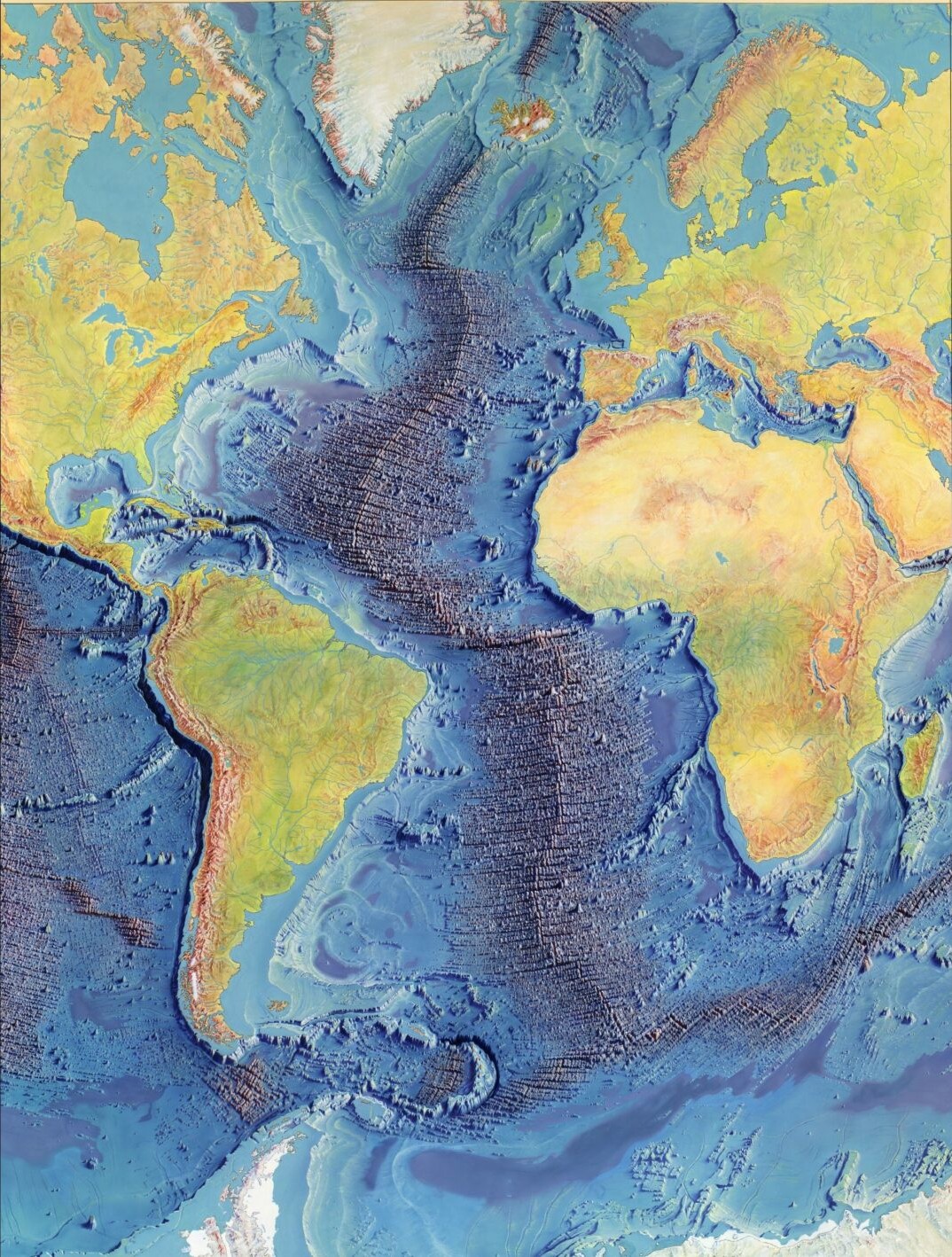
What are ocean basins?
"We can only sense that in the deep and turbulent recesses of the sea are hidden mysteries far greater than any we have solved."
-Rachel Carson, The Sea Around Us, 1957
What are ocean basins?
Mohorovičić discontinuity
Mohorovičić discontinuity
What are the differences between lithosphere and asthenosphere and crust and mantle?
Mohorovičić discontinuity
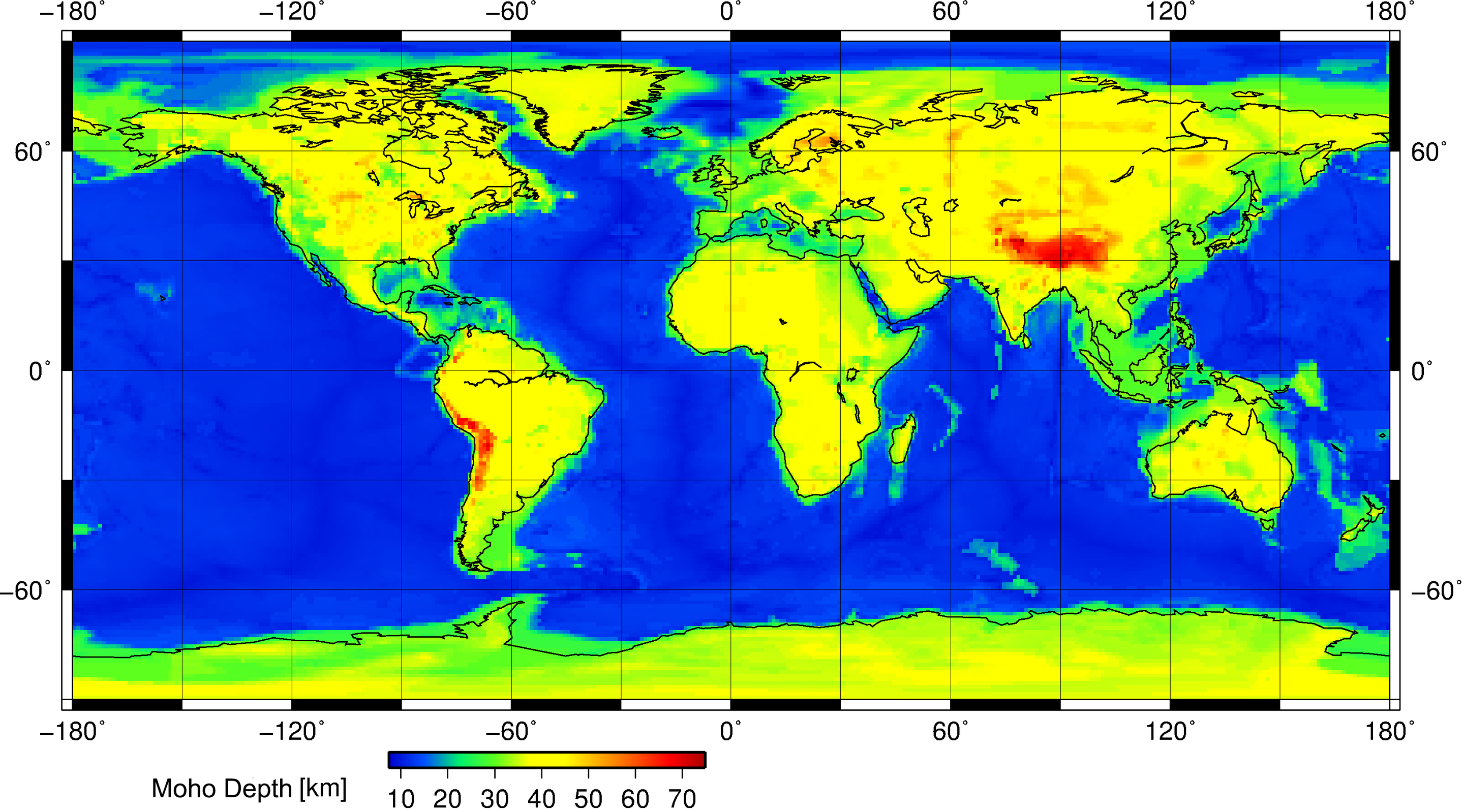
"Seismic evidence shows that the so-called crustal thickness-depth to the M discontinuity-is 6 km under oceans and 34 km under continents on the average." Gravity data prove that these two types of crustal columns have the same mass-the pressure at some arbitrary level beneath them, such as 40 km, would be the same. They are in hydrostatic equilibrium."
-Harry Hess, History of Ocean Basins, 1962
Mohorovičić discontinuity
"Seismic evidence shows that the so-called crustal thickness-depth to the M discontinuity-is 6 km under oceans and 34 km under continents on the average. Gravity data prove that these two types of crustal columns have the same mass-the pressure at some arbitrary level beneath them, such as 40 km, would be the same. They are in hydrostatic equilibrium."
-Harry Hess, History of Ocean Basins, 1962
Mohorovičić discontinuity
"Seismic evidence shows that the so-called crustal thickness-depth to the M discontinuity-is 6 km under oceans and 34 km under continents on the average. Gravity data prove that these two types of crustal columns have the same mass-the pressure at some arbitrary level beneath them, such as 40 km, would be the same. They are in hydrostatic equilibrium."
-Harry Hess, History of Ocean Basins, 1962
How can we test this assumption?
Testing isostatic equilibrium
"Seismic evidence shows that the so-called crustal thickness-depth to the M discontinuity-is 6 km under oceans and 34 km under continents on the average. Gravity data prove that these two types of crustal columns have the same mass-the pressure at some arbitrary level beneath them, such as 40 km, would be the same. They are in hydrostatic equilibrium."
-Harry Hess, History of Ocean Basins, 1962
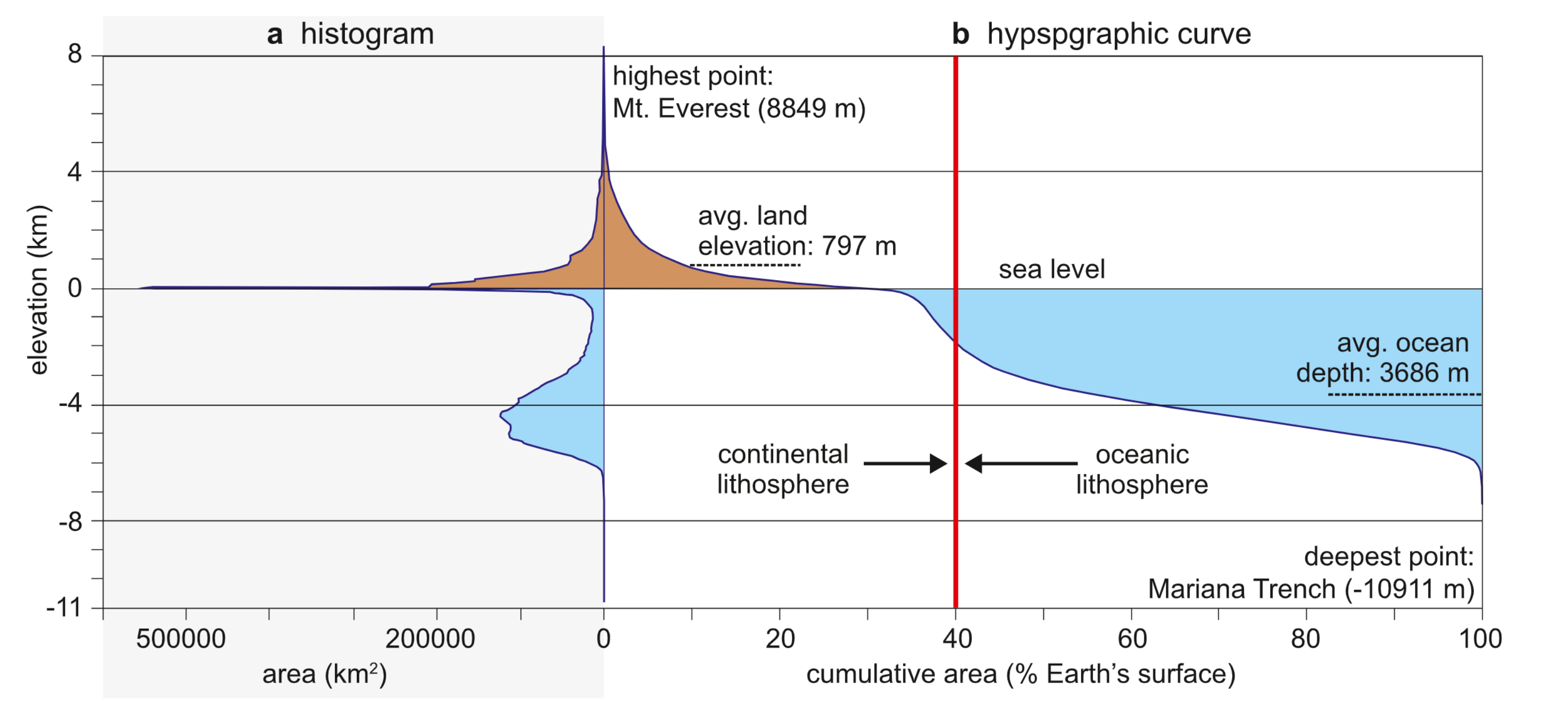
- Continental crust:
- Mean elevation: 797 m
- Mean thickness: 34 km
- Andesite with density: 2.8 g/cm3
- Density of water: 1 g/cm3
- Oceanic crust:
- Mean elevation: -3686 m
- Mean thickness: 6 km
- Basalt with density: 2.9 g/cm3
Testing isostatic equilibrium
You should get 3.46 g/cm3 (density of peridotite: 3.1–3.4 g/cm3) using the following mass balance:
$$ \mathrm{ \Delta H_{cc}\rho_{cc} = \Delta H_{w}\rho_{w} + \Delta H_{oc}\rho_{oc} + \Delta H_m\rho_m \\ ~\\ \Delta H_{cc}\rho_{cc} - \Delta H_{w}\rho_{w} - \Delta H_{oc}\rho_{oc} = \Delta H_m\rho_m \\ ~\\ \frac{\Delta H_{cc}\rho_{cc} - \Delta H_{w}\rho_{w} - \Delta H_{oc}\rho_{oc}}{\Delta H_m} = \rho_m \\ ~\\ \Delta H_m = \Delta H_{cc} - \Delta H_{oc} - E_{cc} - E_{oc}\\} $$where $\Delta H$ is thickness, $E$ is elevation, $\rho$ is density, and the subscripts $w$, $cc$, $oc$, and $m$ correspond to the water in the ocean, the continental crust, the oceanic crust, and the mantle, respectively.
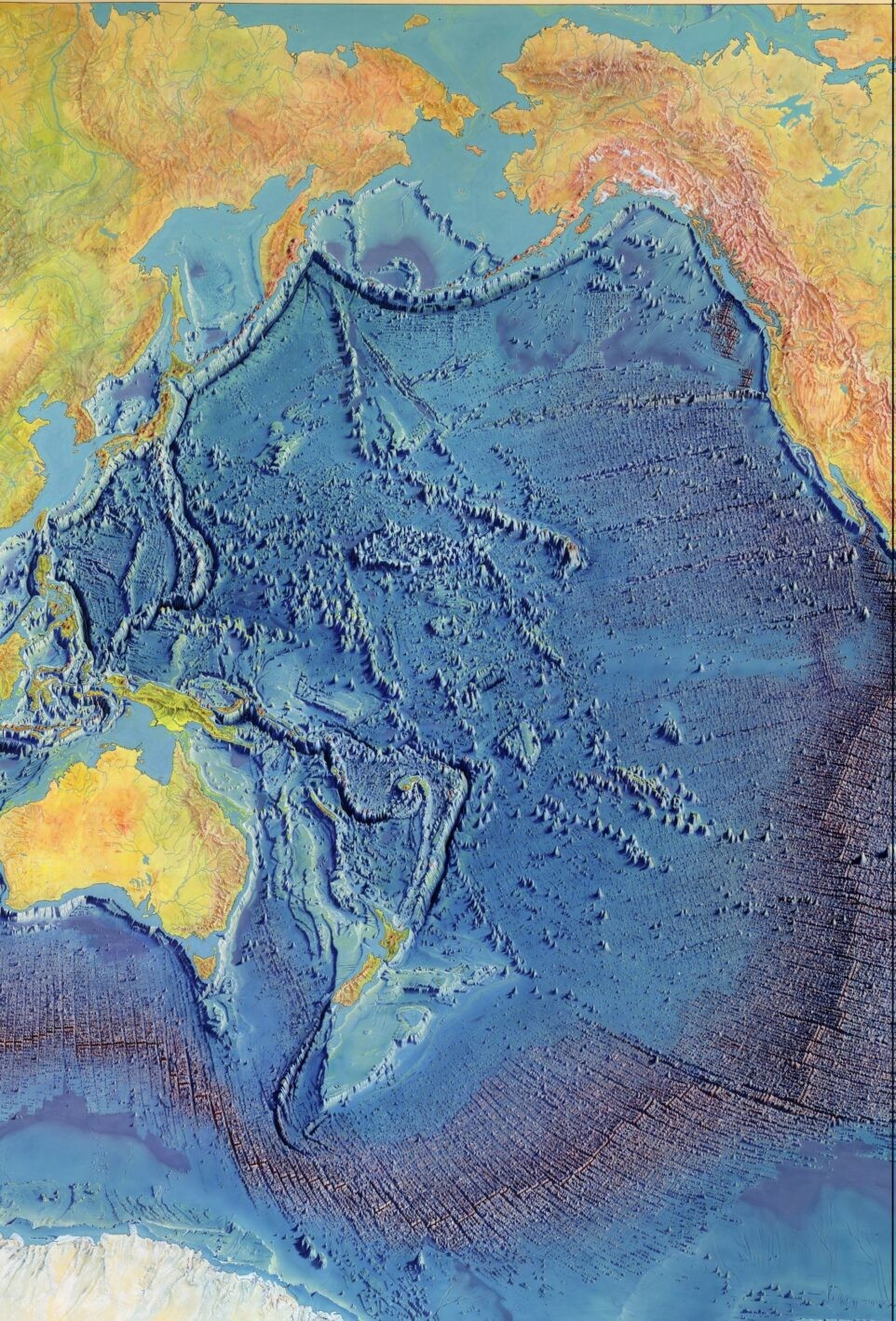
The topography of the sea-floor
The topography of the sea-floor
The topography of the sea-floor
The topography of the sea-floor
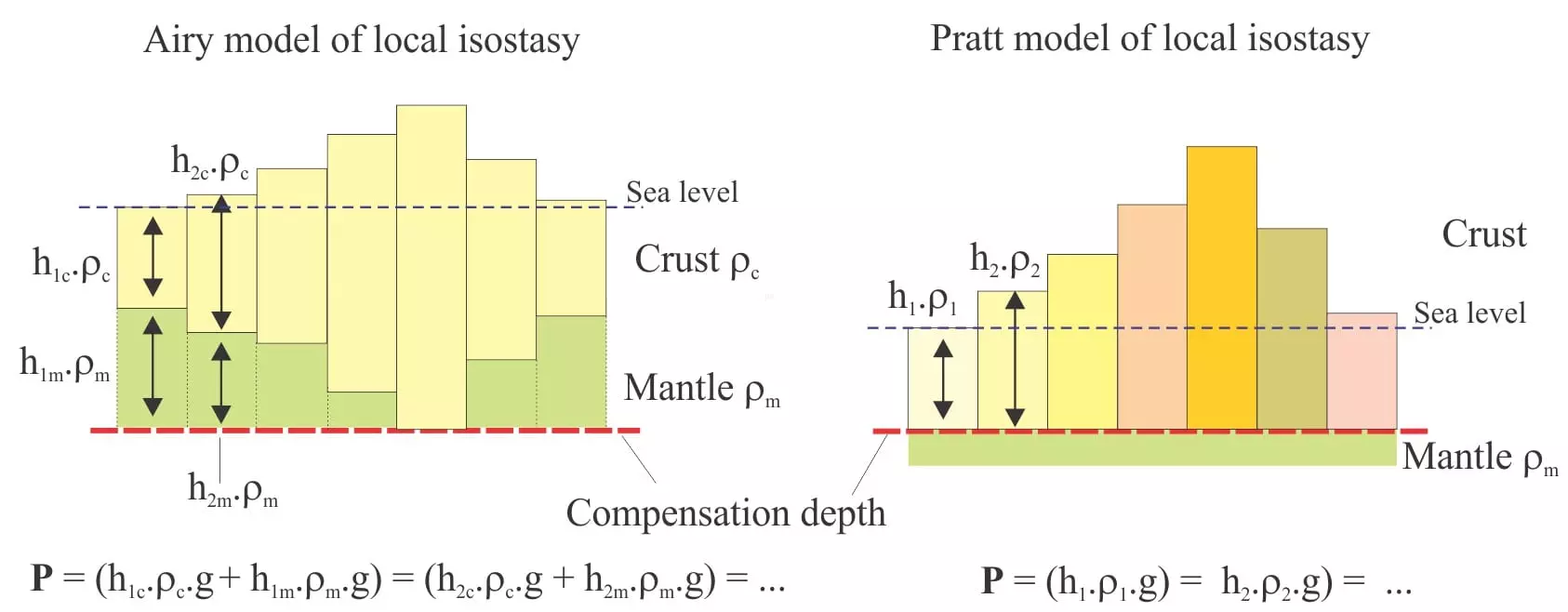
Which model is better at explaining sea-floor topography? Why?
The topography of the sea-floor
"Nevertheless, mantle convection is considered a radical hypothesis not widely accepted by geologists and geophysicists. If it were accepted, a rather reasonable story could be constructed to describe the evolution of ocean basins and the waters within them. Whole realms of previously unrelated facts fall into a regular pattern, which suggests that close approach to satisfactory theory is being attained."
-Harry Hess, History of Ocean Basins, 1962