Lecture 8-10: Time in Stratigraphic Sequences

  1. Gross vs. net fluxes
    1. an illustrative example
    2. diastems and hiatuses
    3. how to build a rock record
  2. The concept of correlation
    1. Chronostratigraphy (Wheeler diagrams)
  3. Time in the rock record
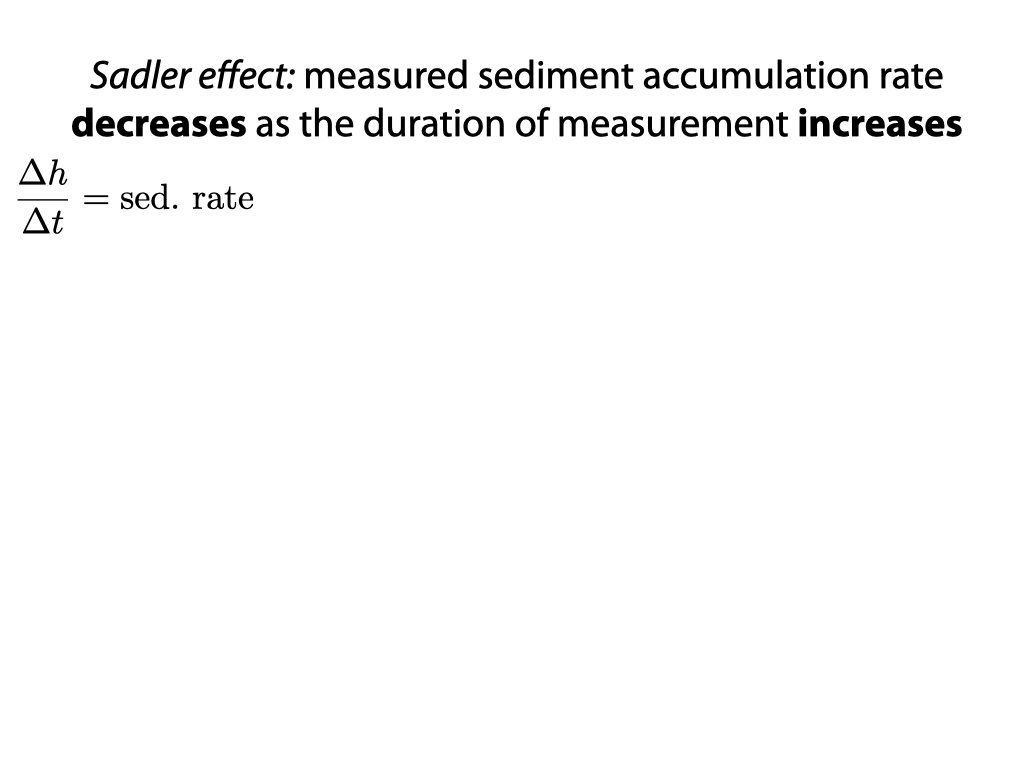
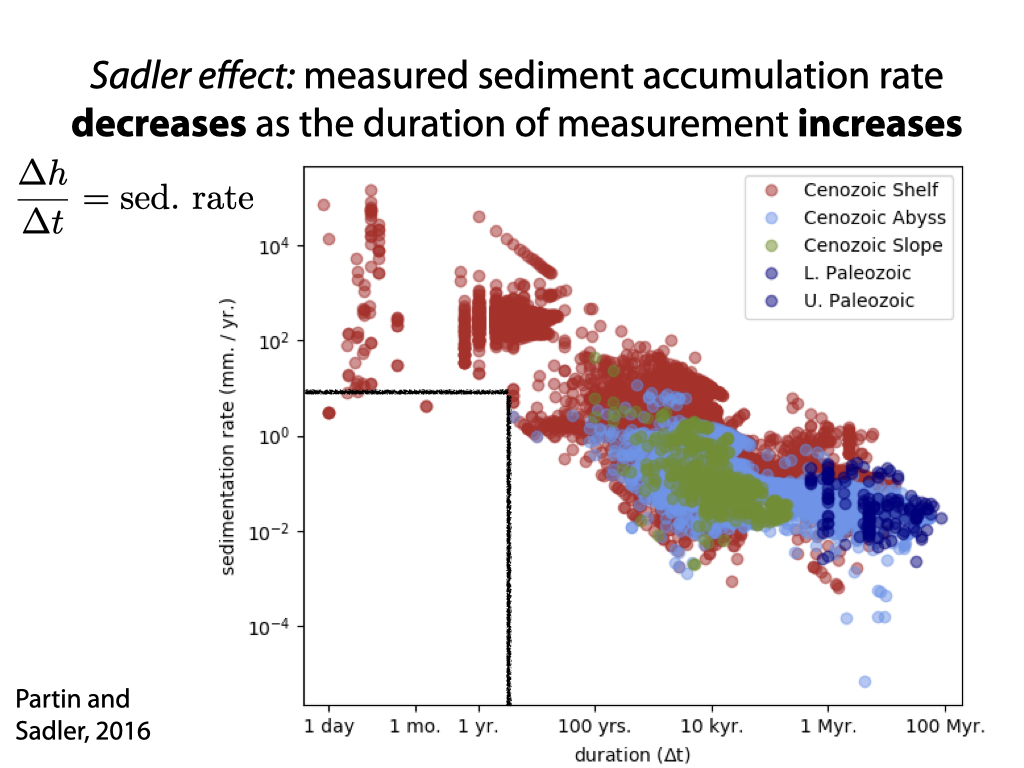
    1. Sadler effect
We acknowledge and respect the lək̓ʷəŋən peoples on whose traditional territory the university stands and the Songhees, Esquimalt and W̱SÁNEĆ peoples whose historical relationships with the land continue to this day.
  • value for respiration comes from (0.1 Pg C / yr) * (0.2) with a CH2O stoichiometry
  • assume any difference between it and GPP is lost to respiration
  • likely still an overestimate for net O2 production - why?
  • not the only way to lose O2, can also oxidize Fe2+ and S2-

Gross vs. Net fluxes

\begin{align} CO_2 + H_20 + \mathrm{energy} \underset{\color{red}{respiration}}{\stackrel{\color{blue}{photosynthesis}}{\rightleftharpoons}} CH_2O + O_2\\ \mathrm{Net~flux~(O_2~into~atm) = \color{blue}{photosynthesis} - \color{red}{respiration}} \end{align}

\begin{align} \mathrm{sediment} + \mathrm{movement} \underset{\color{red}{erosion}}{\stackrel{\color{blue}{deposition}}{\rightleftharpoons}} \mathrm{topography}\\ \mathrm{Net~topography = \color{blue}{deposition} - \color{red}{erosion}} \end{align}

both depend on rate!!
  • the universe does not bend towards more O2 or more rock!
  • if we wait for some period of time, perhaps we would lose all our rock, or all our O2

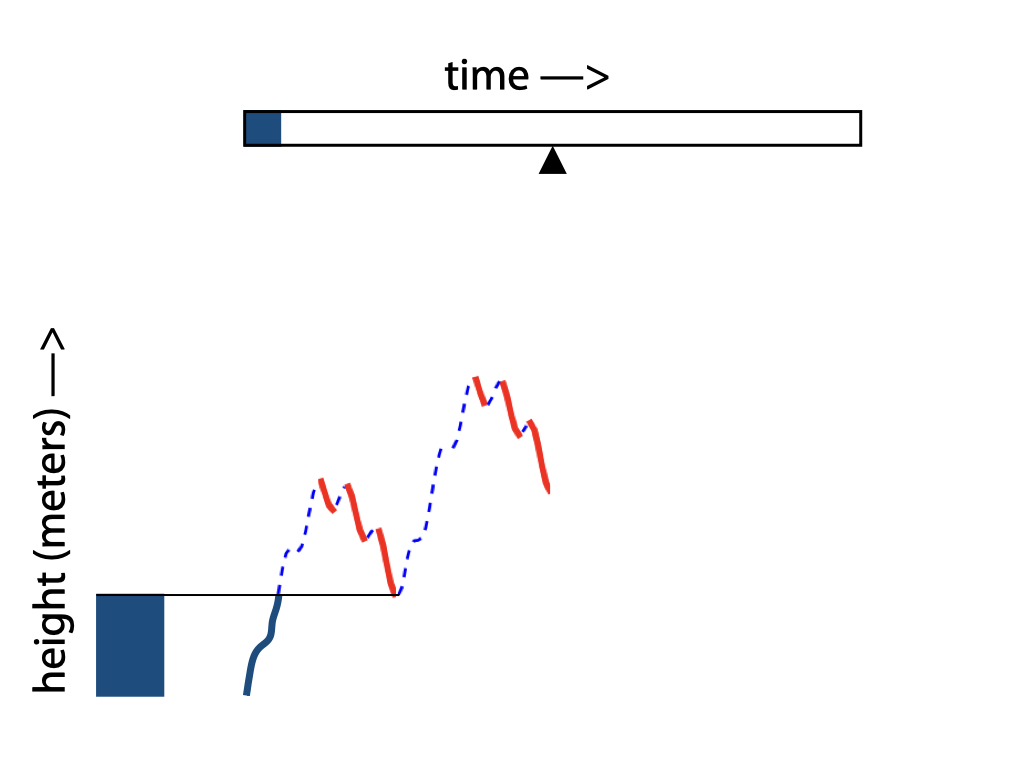
Gross and net sedimentation

No description has been provided for this image

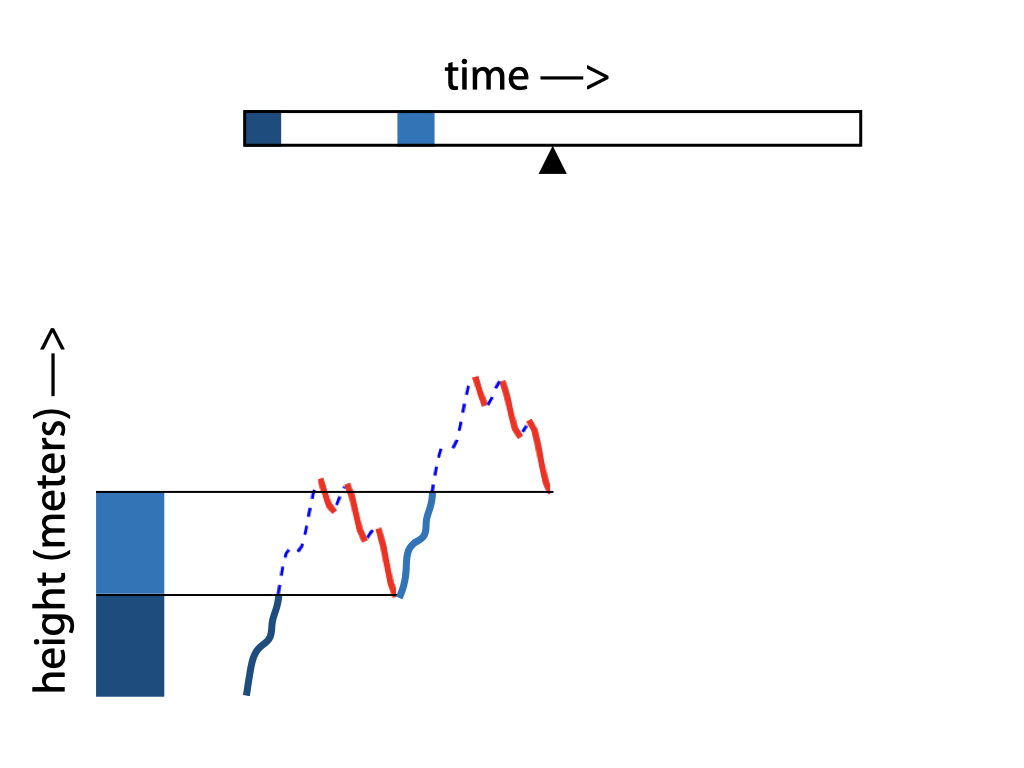
Gross and net sedimentation

No description has been provided for this image

Gross and net sedimentation

No description has been provided for this image

Gross and net sedimentation

No description has been provided for this image

Gross and net sedimentation

No description has been provided for this image

Gross and net sedimentation

No description has been provided for this image

Gross and net sedimentation

No description has been provided for this image

Gross and net sedimentation

No description has been provided for this image

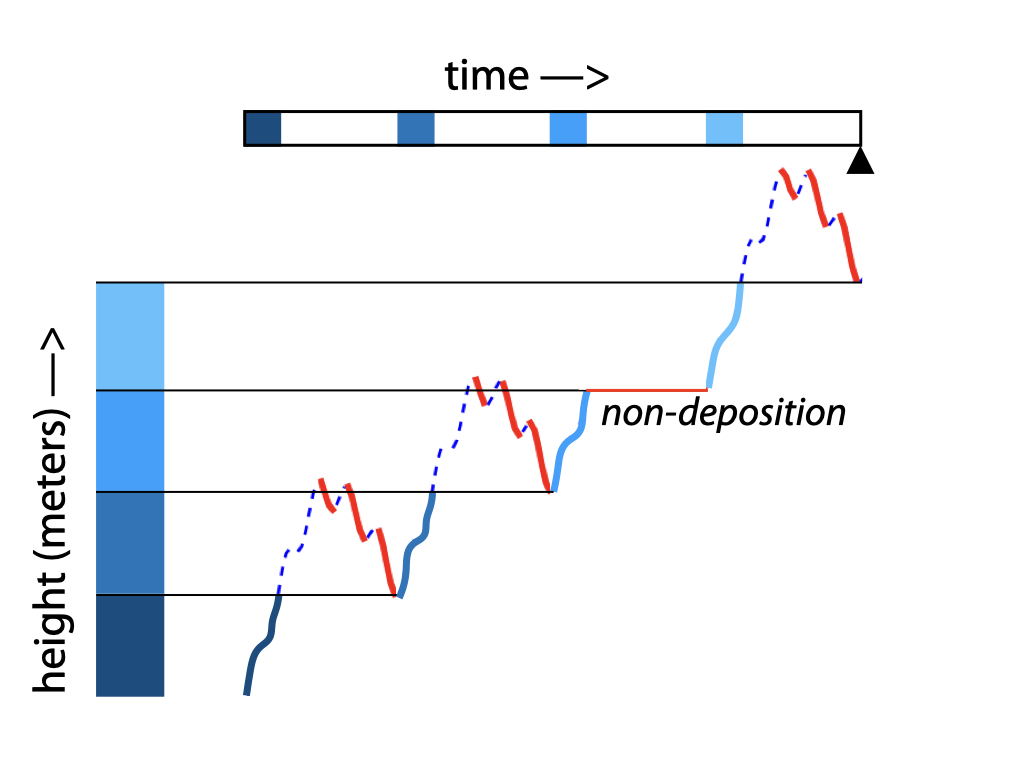
net sedimentary record is full of gaps: both erosive surfaces and hiatuses.

How much time is represented by sedimentary rock?

  • unless we can recognize these surfaces, net sedimentation looks pretty continuous
  • in fact, only 25% of the elapsed time is represented as ROCK
  • remainder is contained in the gaps!

How to build the net rock record

In [4]:
import csv
import numpy as np
from matplotlib import pyplot as plt
import seaborn as sns
sns.set_context('talk')
%matplotlib inline

#empty lists for data
model_topo=[]

#open the data file
with open("../Assignments/Assignment_1/Assignment_1p3/data/model_results.csv","r") as fid:
    data = csv.reader(fid, delimiter=",")

    #reads the data in line-by-line
    for row in data:
        model_topo.append([float(r) for r in row[1:]])

#convert to list of numpy arrays
model_topo=[np.array(t) for t in model_topo]

#define as change from inital conditions 
model_topo=[t-model_topo[0] for t in model_topo]
  • now lets see how we can build the net rock record from our diffusion model outputs - this is something that is needed for Assignment 1.3, question 2
  • importing model topography (measured at 1000 grid points) through time (201 timesteps)
  • first defining topography as DIFFERENCE in topography between end and beginning of model

How to build the net rock record

In [5]:
#pull topographic evolution from one spot in the basin
section=[t[454] for t in model_topo]

plt.plot(section,'-',color='r')
plt.plot(np.arange(len(section))[0::4],section[0::4],'.',markersize=5,color='k')

plt.gca().set_xticks([])
plt.gca().set_xlabel(r'time $\rightarrow$')
plt.gca().set_ylabel('height (meters)')
plt.gca().xaxis.set_label_position('top')  
No description has been provided for this image
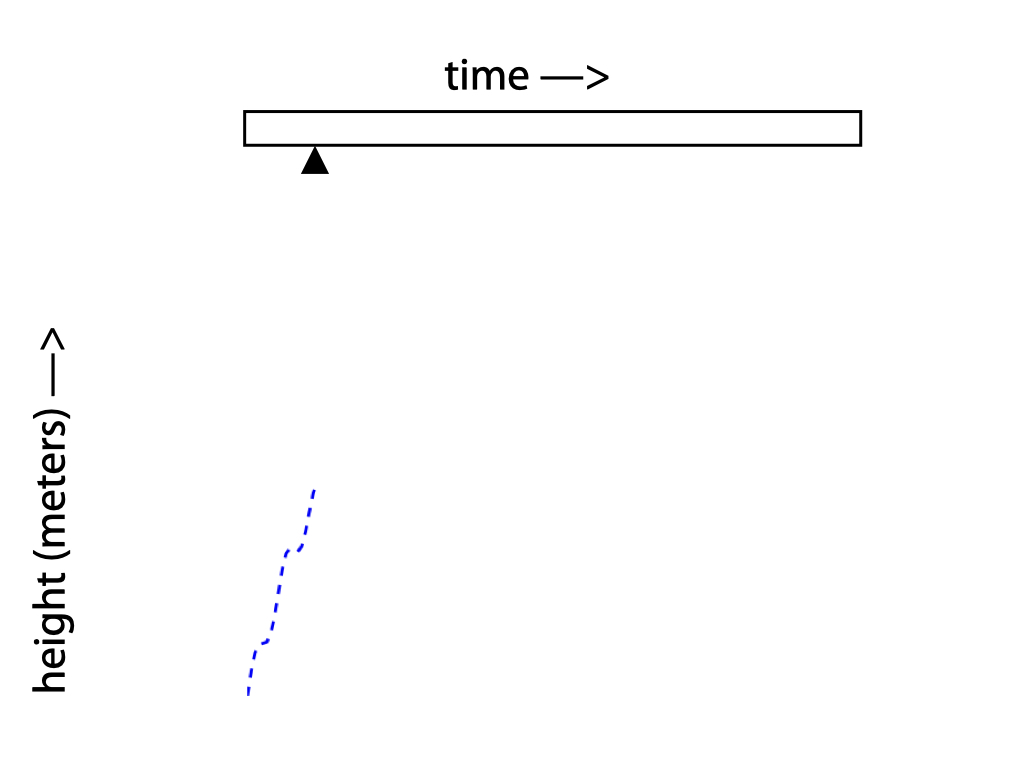
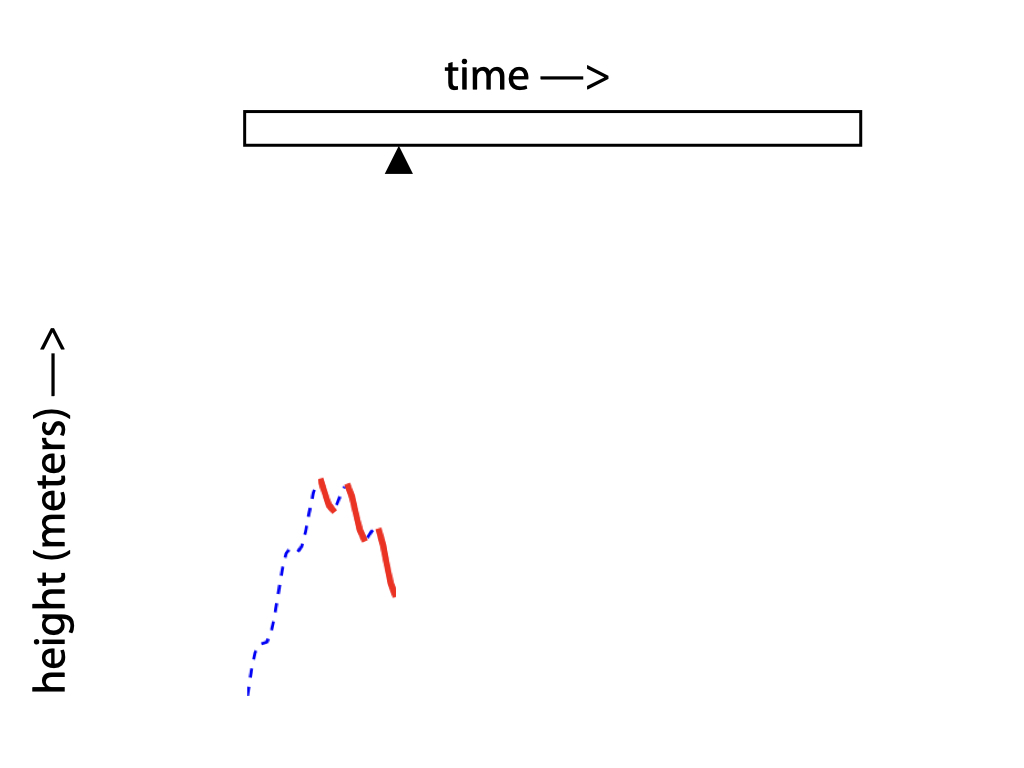
  • so let's plot up topographic evolution for one grid point (in this case, its 4.54 kilometers into our basin)
  • can people spot the periods of erosion and/or hiatuses? Mark them up!
  • so how do we go from this trajectory to the net rock record? has anyone made progress on this question?
  • I will show one way, might not be the best way
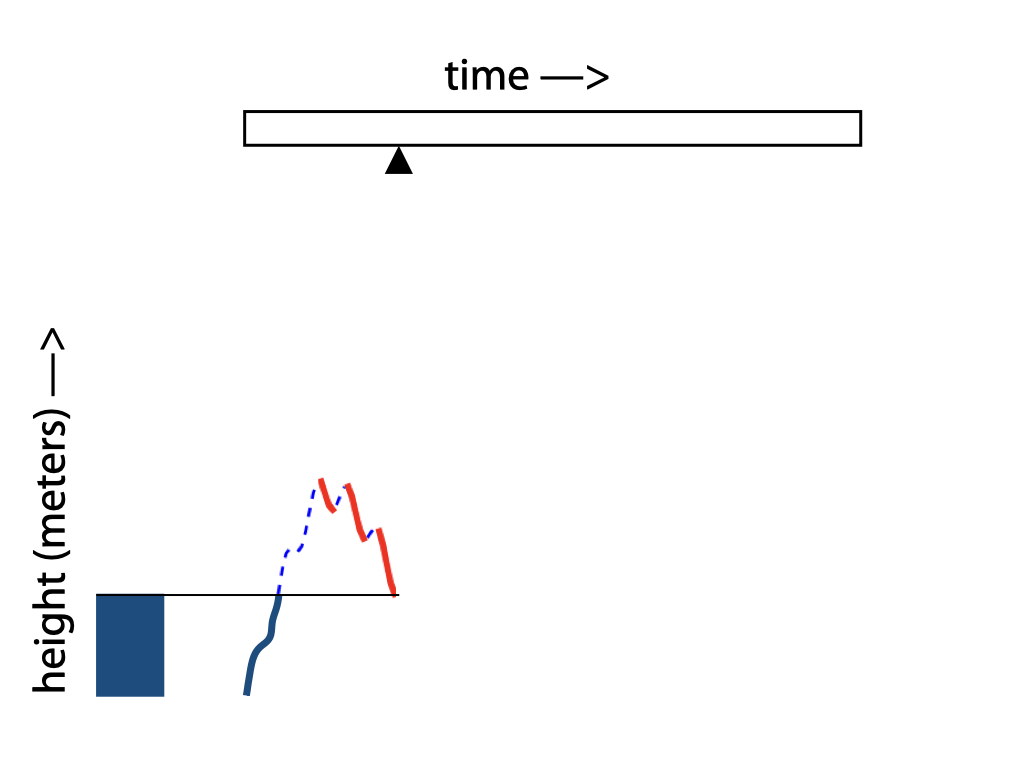
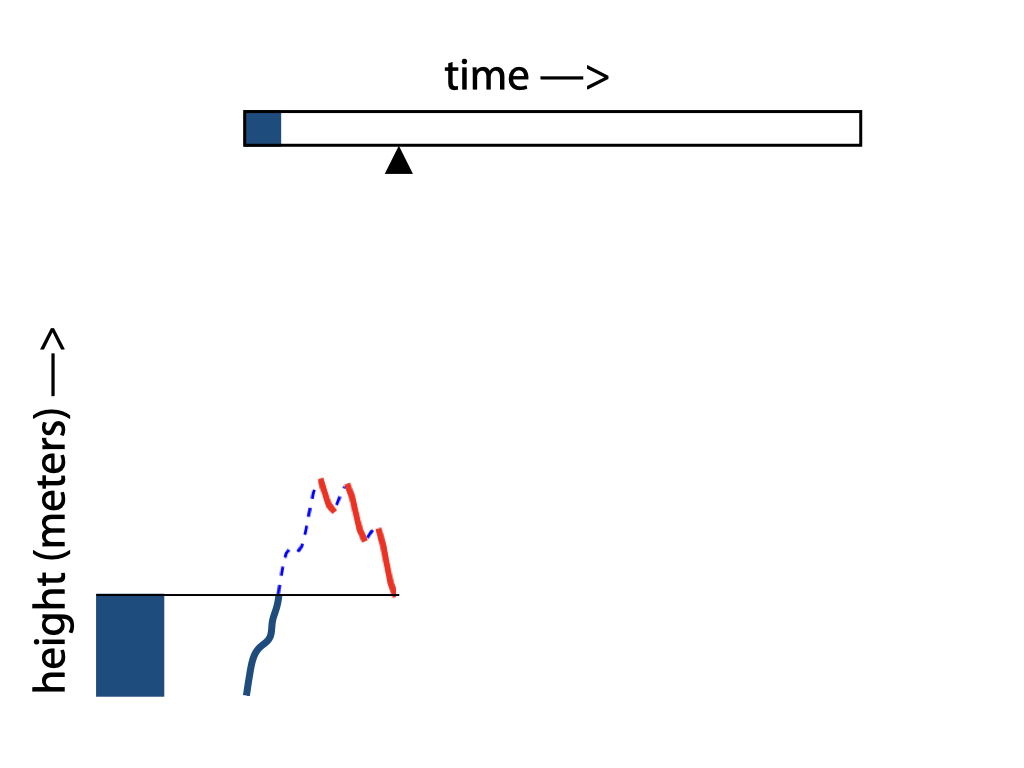
  • helpful to work BACKWARDS - start at the end, and burrow your way to the beginning
  • at each black dot, look backwards in time - has topography INCREASED or DECREASED?

How to build the net rock record

In [3]:
net=np.flipud(section) #flip this stratigraphy upside down to examine youngest to oldest
for i,s in enumerate(net): #count through time slices starting at the youngest
    if i!=len(net)-1: #if we're not at the end
        #look "down section" - was this layer eroded?
        # --> if height had decreased, then yes
        if s<net[i+1]: #s is height of current timeslice, net[i+1] is heigh of previous timeslice
            net[i+1]=s #create new record of net sedimentation
#make stratigraphy younging upwards again
net=np.flipud(net)
plt.plot(net,color='b')
plt.fill_between(np.arange(len(section)),section,net,color='r',alpha=0.25)
plt.gca().set_xticks([])
plt.gca().set_xlabel(r'time $\rightarrow$')
plt.gca().set_ylabel('height (meters)')
plt.gca().xaxis.set_label_position('top') 
No description has been provided for this image
  • this is exactly what this code is doing for this particular section location
  • plot it up, and we can see that we've identified the period of erosion

How to build the net rock record

No description has been provided for this image
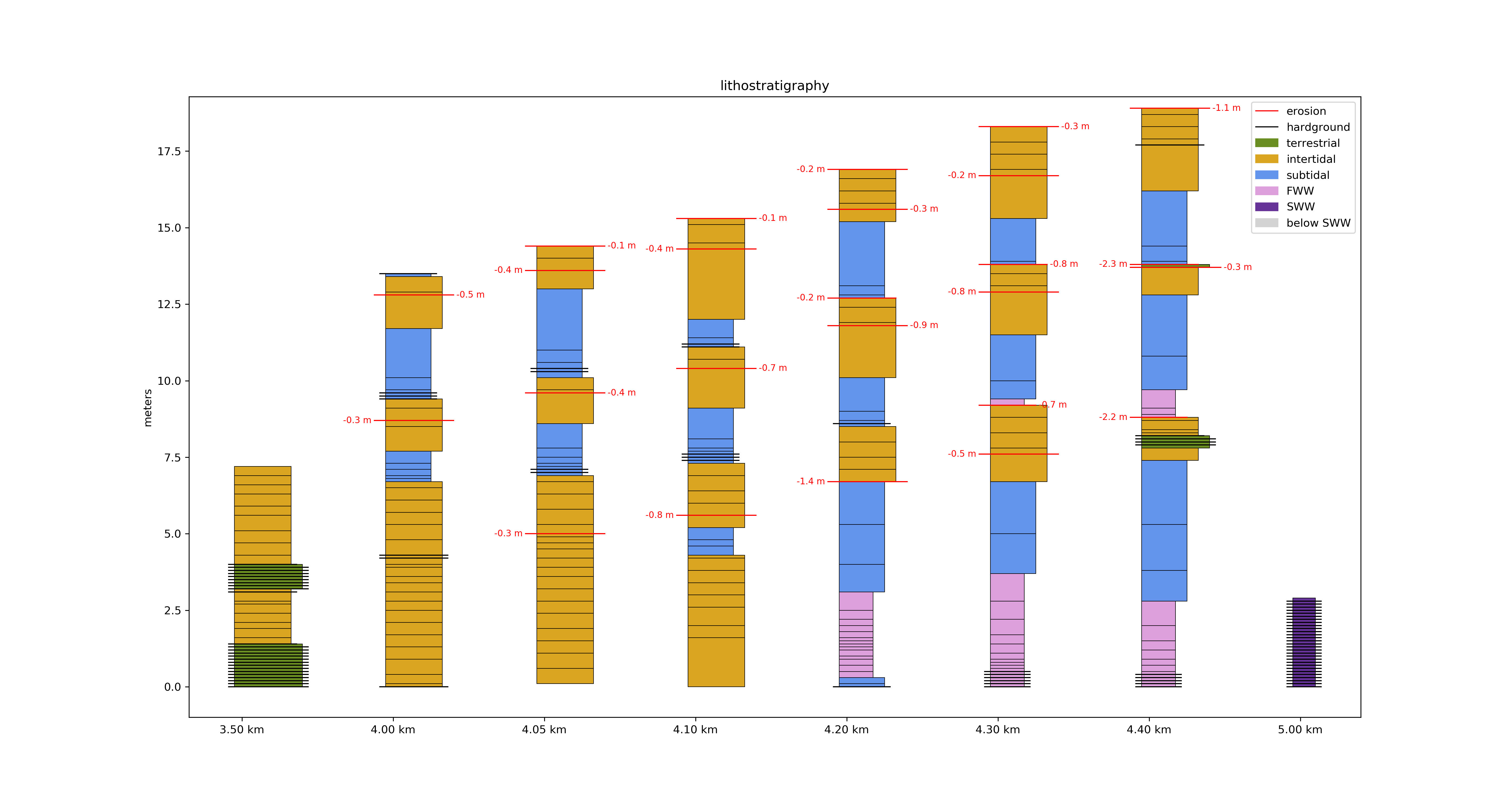
  • so I have applied that same algorithm throughout my model basin, and this allows me to make strat sections like this
  • can also mark EROSIVE SURFACES and NON-DEPOSITION SURFACES (which are sometimes called hardgrounds, especially when dealing with carbonate lithologies)
  • each erosive surface is marked by how much sediment was created and then later destroyed
  • this is the "field geologists" view of things.
  • Imagine we had a slice through our model basin. Finding its base (datum = 0m), and measuring up. Making notes about sedimentary features and structures to make some inference about water depth (wider boxes = shallower) and erosion surfaces / hiatuses

Chronostratigraphy and Wheeler Diagrams
No description has been provided for this image
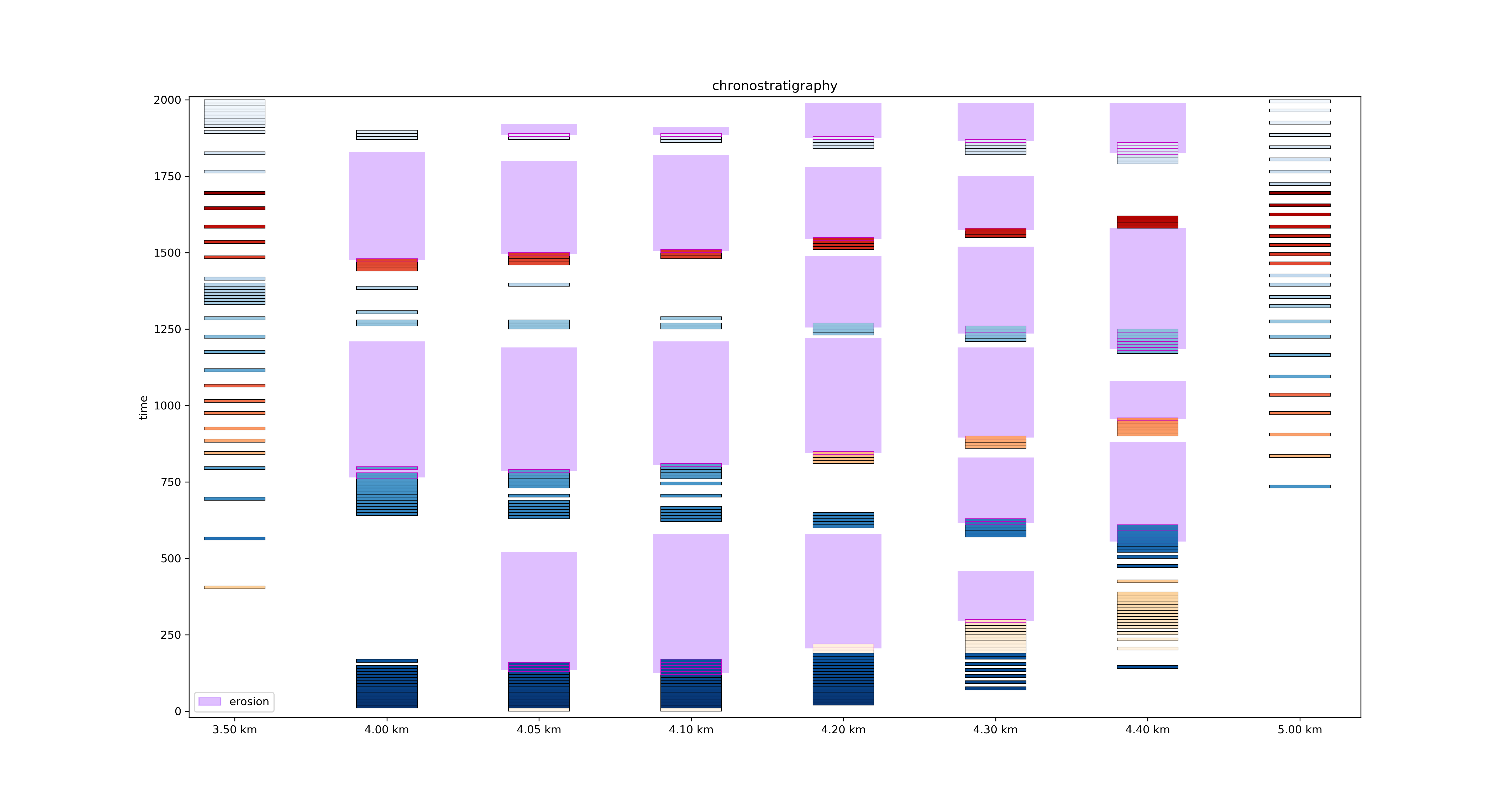
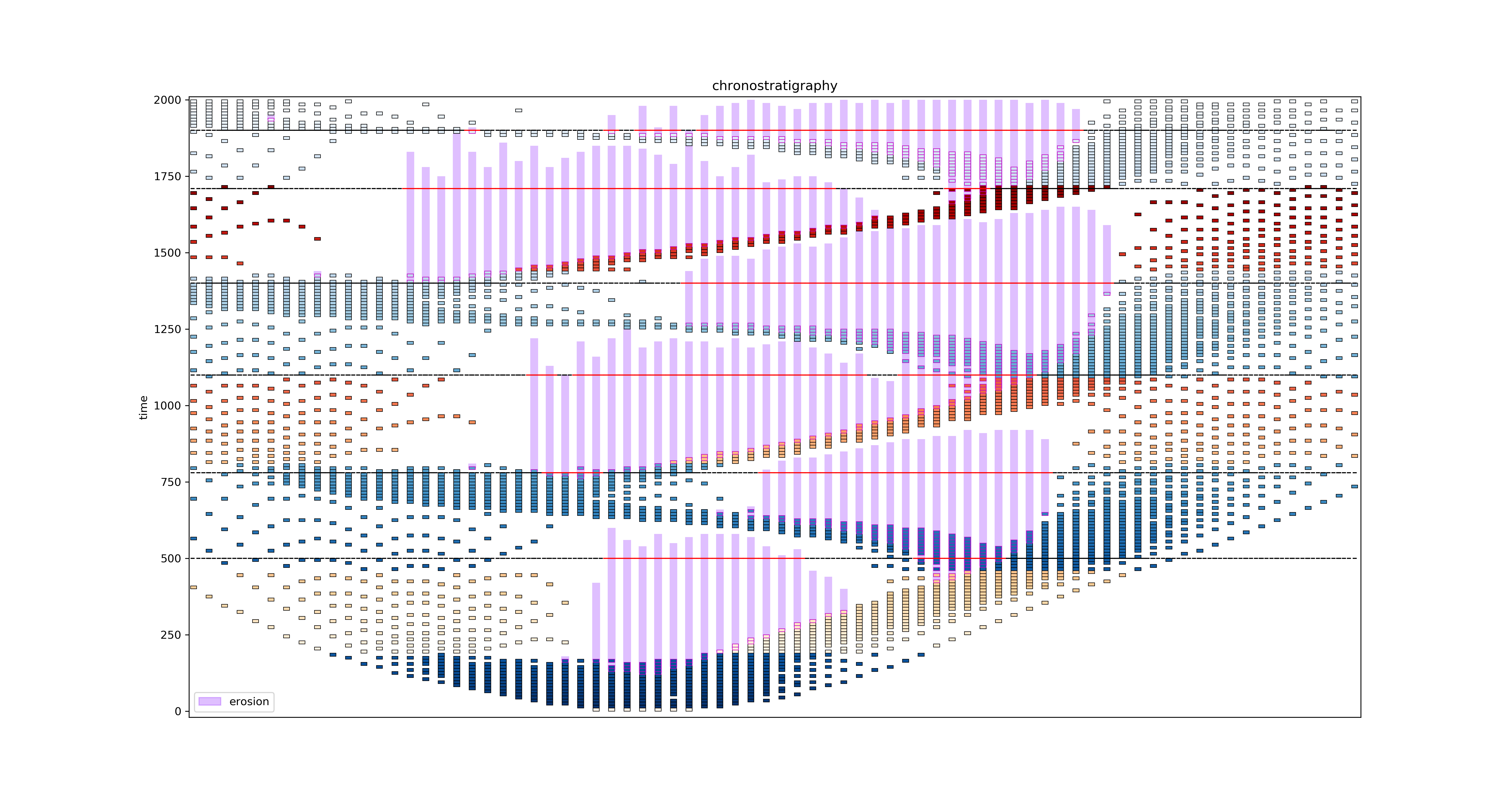
  • Now, let's take a "time" view of these stratigraphic column
  • this view is sometimes called a chronostratigraphic chart, or a Wheeler diagram
  • y-axis is time (top = end of model run)
  • x-axis is showing presence / absense of rock at that time. Height is NOT thickness!
  • white space is NON-DEPOSITION
  • purple space is when EROSION was occuring, gobbling up previously deposited sediment
  • can you make some observations about sedimentation occured in this basin?
  • gappiest at the proximal and distal ends - FAR FROM SED SOURCE
  • when sedimentaiton occurs, most complete in the middle portion
  • also most erosive - LARGE GRADIENTS
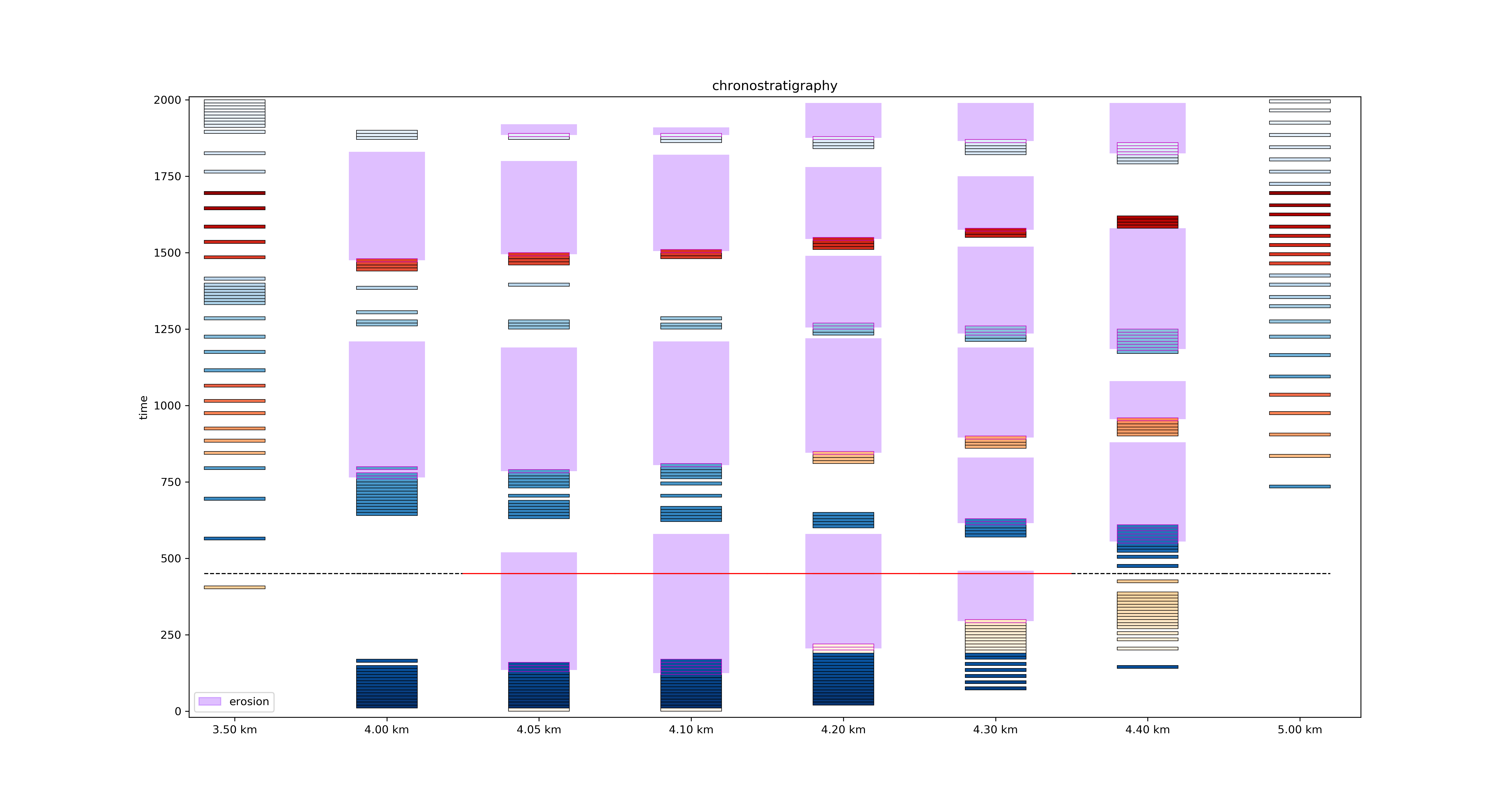
  • so what would a line of correlation look like on a Wheeler diagram CORRELATION = EQUAL TIME, SO FLAT

Chronostratigraphy and Wheeler Diagrams
No description has been provided for this image
  • would it be flat in a lithostratigraphic column?
  • make predictions of where this line will sit in the end columns vs. the middle columns

Correlating in lithostratigraphic space
No description has been provided for this image
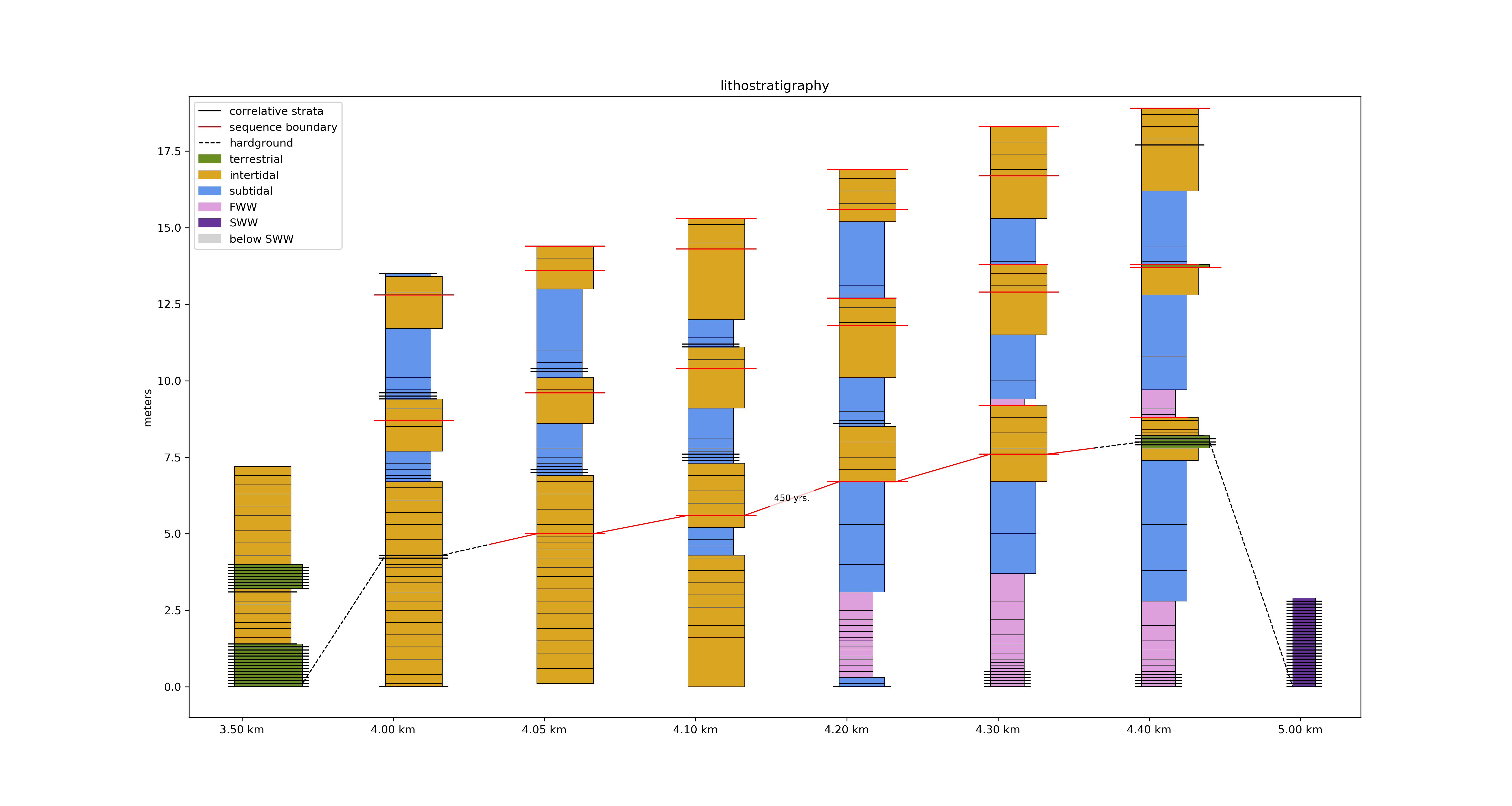
  • so what is going on with this surface?
  • what do you think is going on at this level, with ~5 m deep lithofacies ontop of ~0.1 m deep facies?
  • is subtidal depo going to be SYNCHRONOUS across these columns?
  • time transgressive, but still telling you something about the basin (i.e., there was a transgression, felt across at least part of the basin, just felt at different times)

Correlating in lithostratigraphic space
No description has been provided for this image

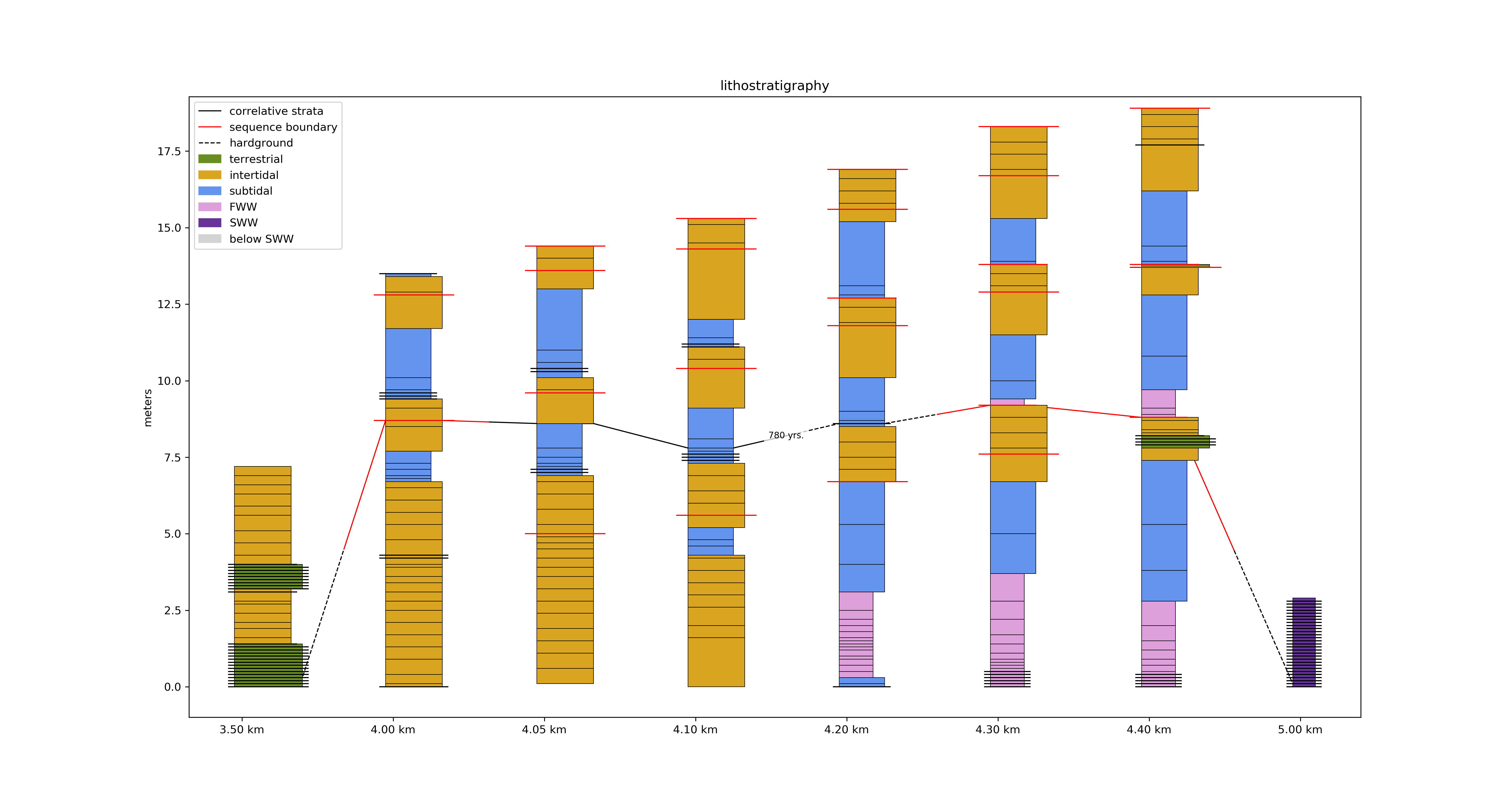
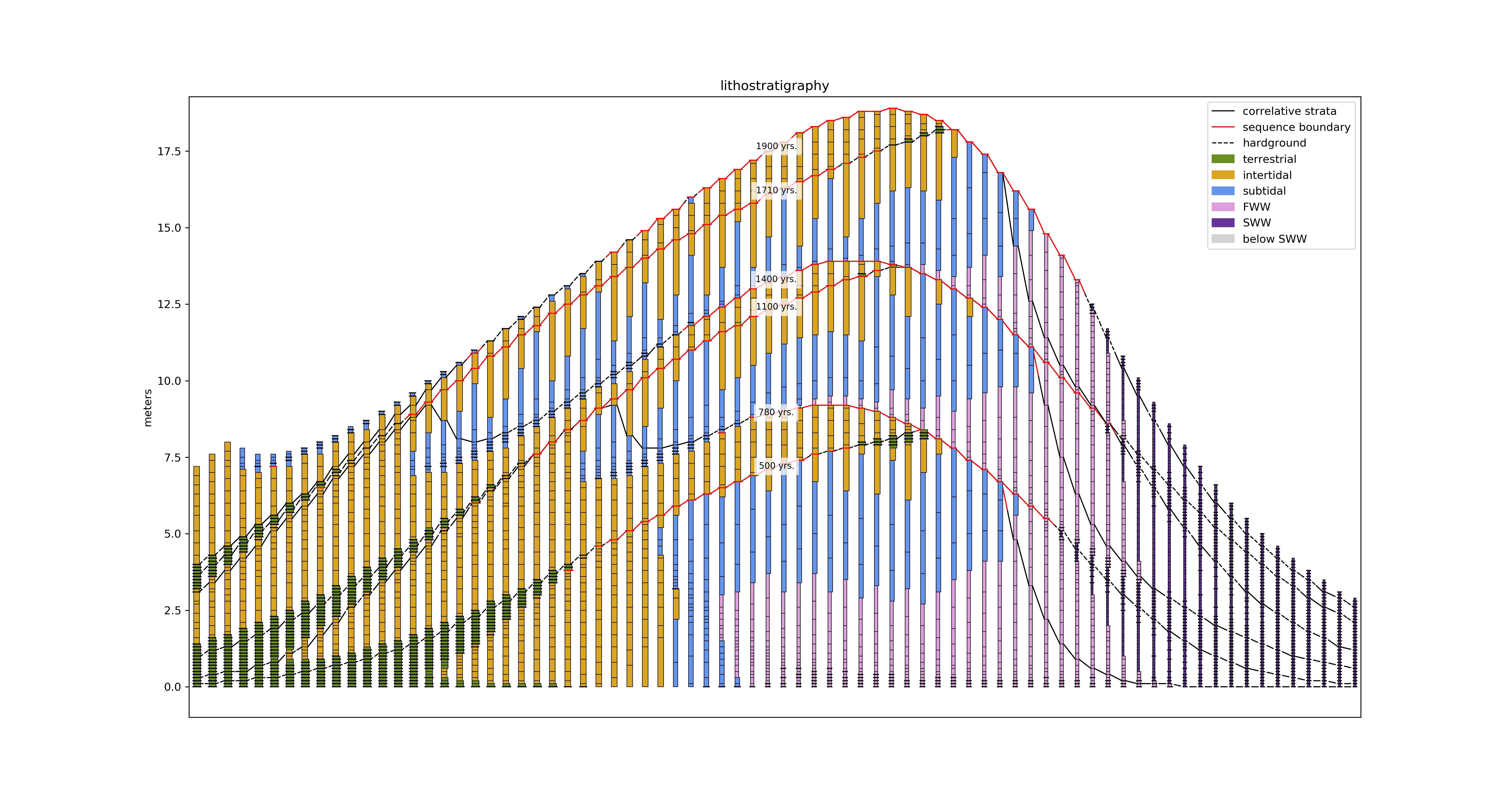
Correlating works best with many sections!
No description has been provided for this image
  • these are fun to just stare at - you really learn a lot
  • below the 780 line, you can see the transgression coming landward, and see that it is time transgressive

Correlating works best with many sections!
No description has been provided for this image
  • this one is especially fun with a beer in hand

Time in the rock record

No description has been provided for this image
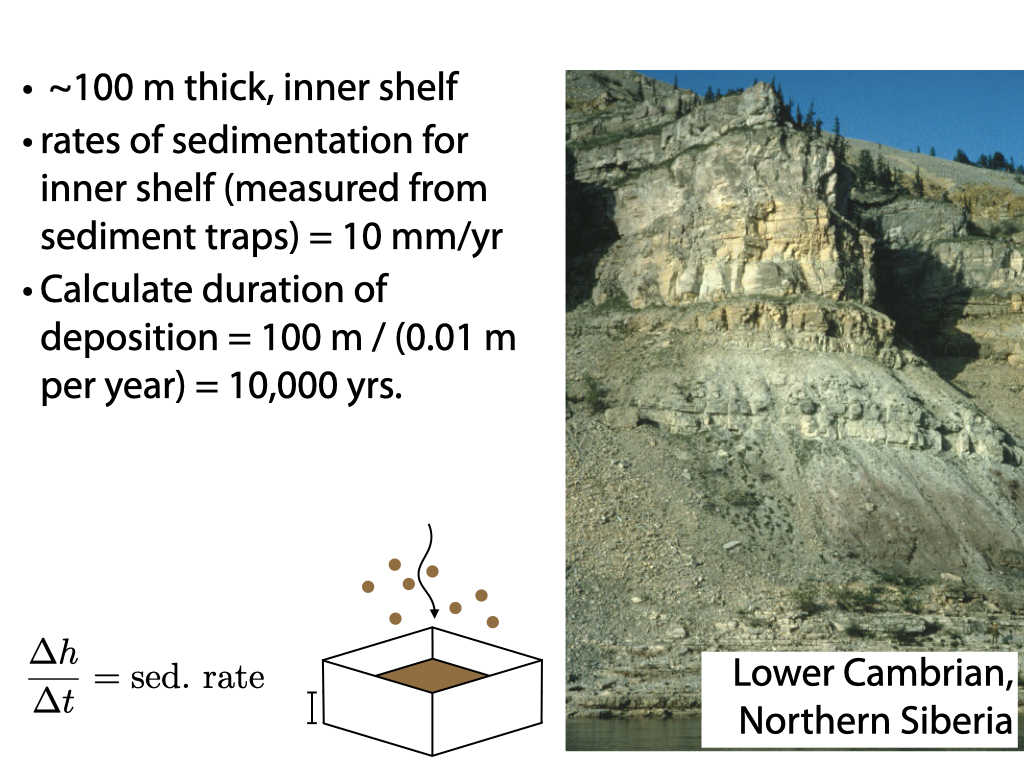
  • okay, so let's end with a very big picture look at how time is distributed in sedimentary records
  • we can get at this question by assessing how well can we tell time, just by looking at thickness?
  • do this in a "past is the key to the present" way
    • by measuring sedimentation rates in analagous settings, and applying them

Time in the rock record

No description has been provided for this image
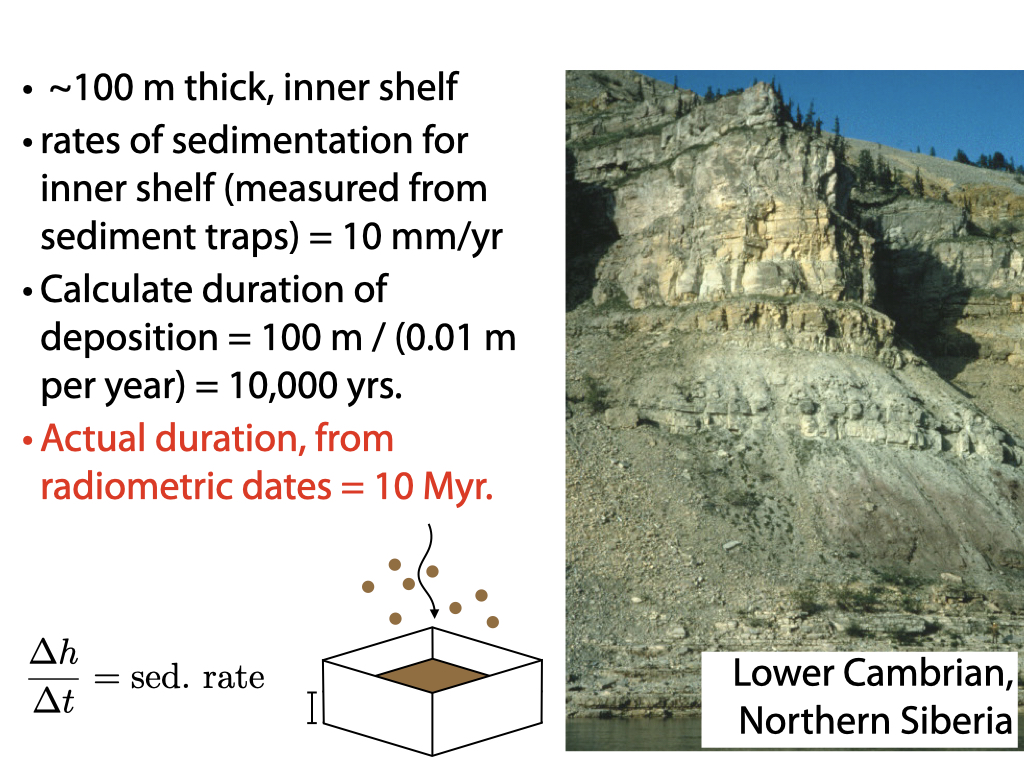
  • but the true answer is very different, as told by dated ash layers at the top and bottom of this succession
  • not a little wrong, but wrong by three orders of magnitude

Time in the rock record

No description has been provided for this image

Time in the rock record

No description has been provided for this image
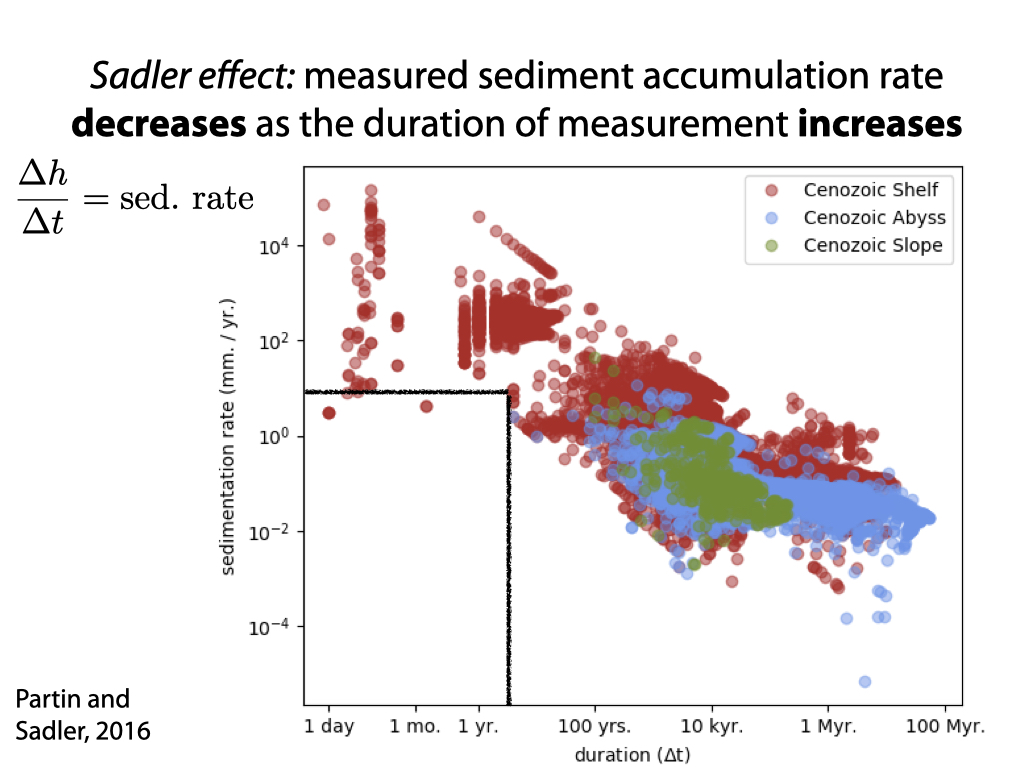
  • can show that prediction through a data compilation of accumulation rates, taken from a range of Cenozoic-aged depositional environments
  • in black are the sediment trap measurements
  • not linear relationship, but a power law relationship Y = kX$^{n}$
  • a straight line on a log-log plot: log$_{10}$(Y) = log$_{10}$(k) + nlog$_{10}$(X)

Time in the rock record

No description has been provided for this image
  • add some deep time examples
  • why are they all at the bottom right corner?

Why is this happening?

No description has been provided for this image
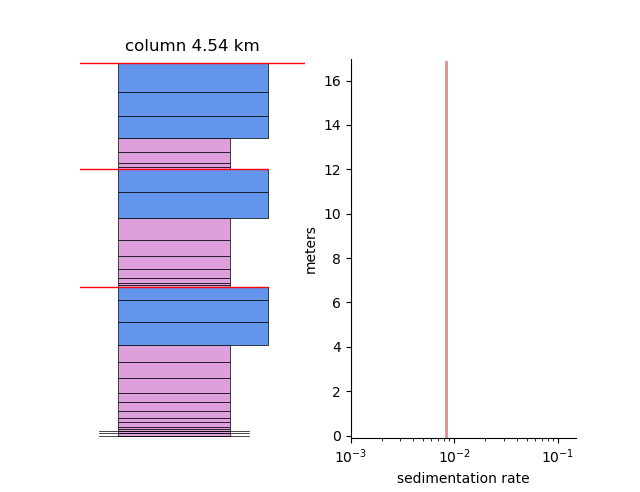
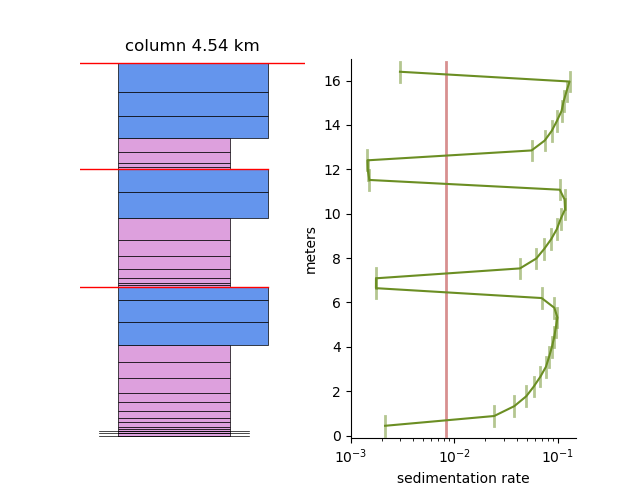
  • how could you get slow accumulation rates, and fast accumulation rates?

Time in our rock record

No description has been provided for this image
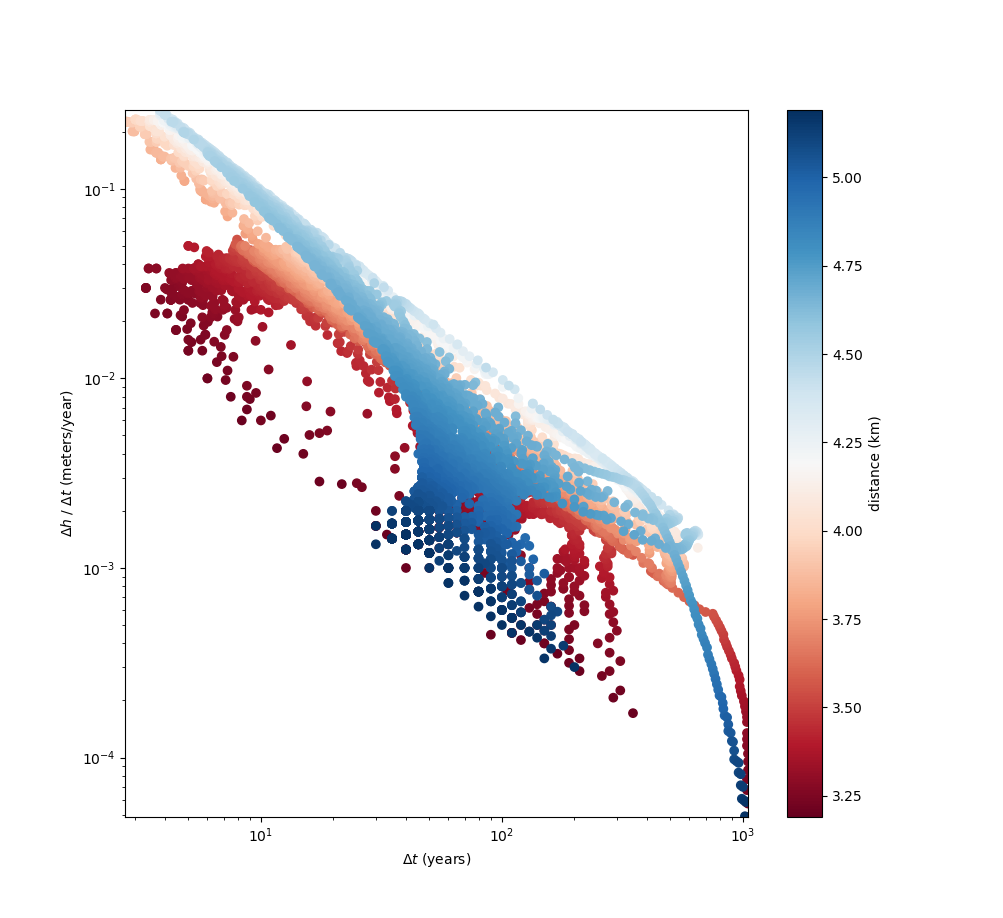
  • we can actually analyze our model outputs, and find the Sadler effect
  • a great demonstrate that our model is doing something real!

Why is this happening?

No description has been provided for this image

Why is this happening?

No description has been provided for this image