Lecture 2: Sea-floor depth, age, and heat flow
- Why do we have ocean basins?
- Mid ocean ridges and the topography of the sea-floor
- Heat transport in the Earth
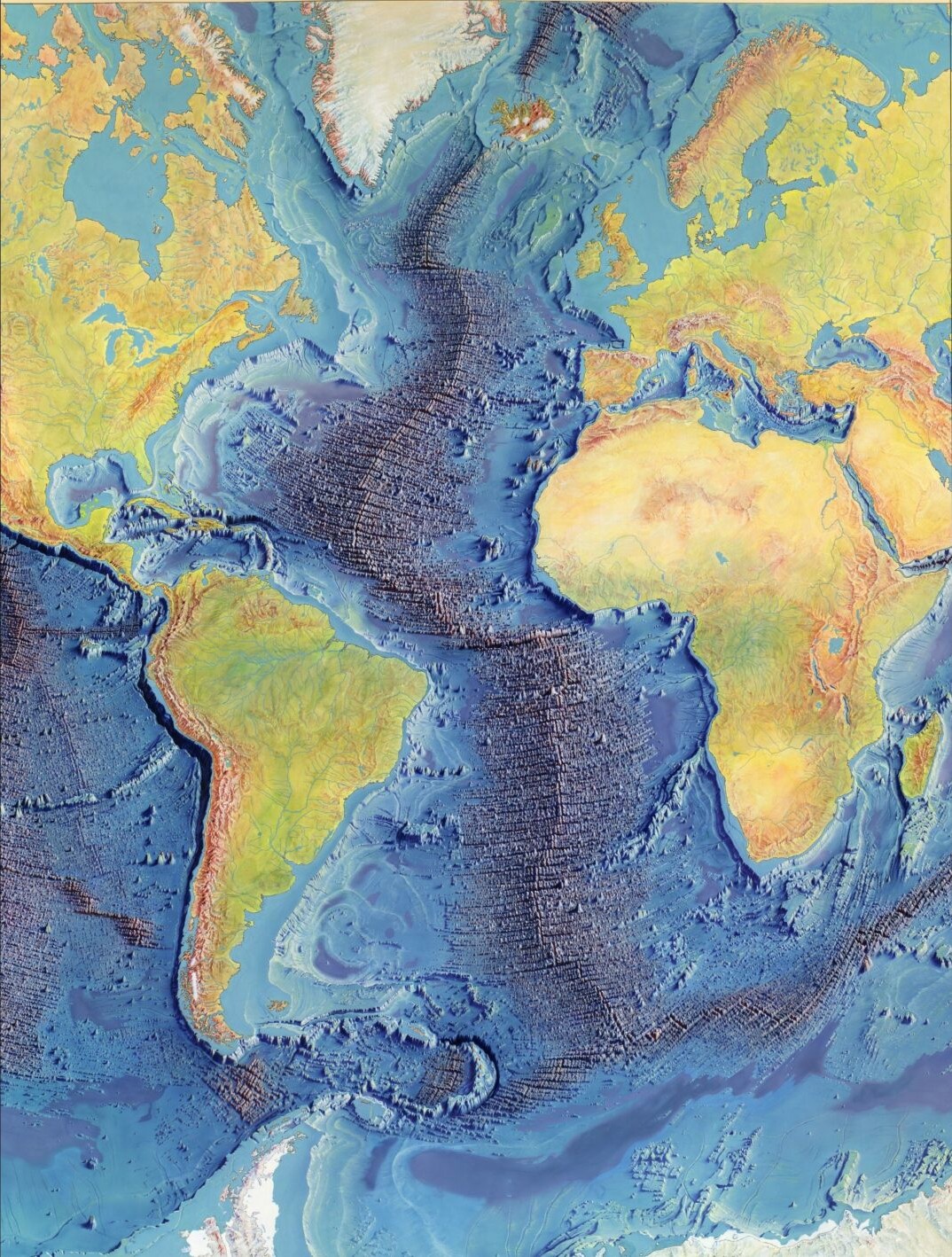
What are ocean basins?
What are ocean basins?
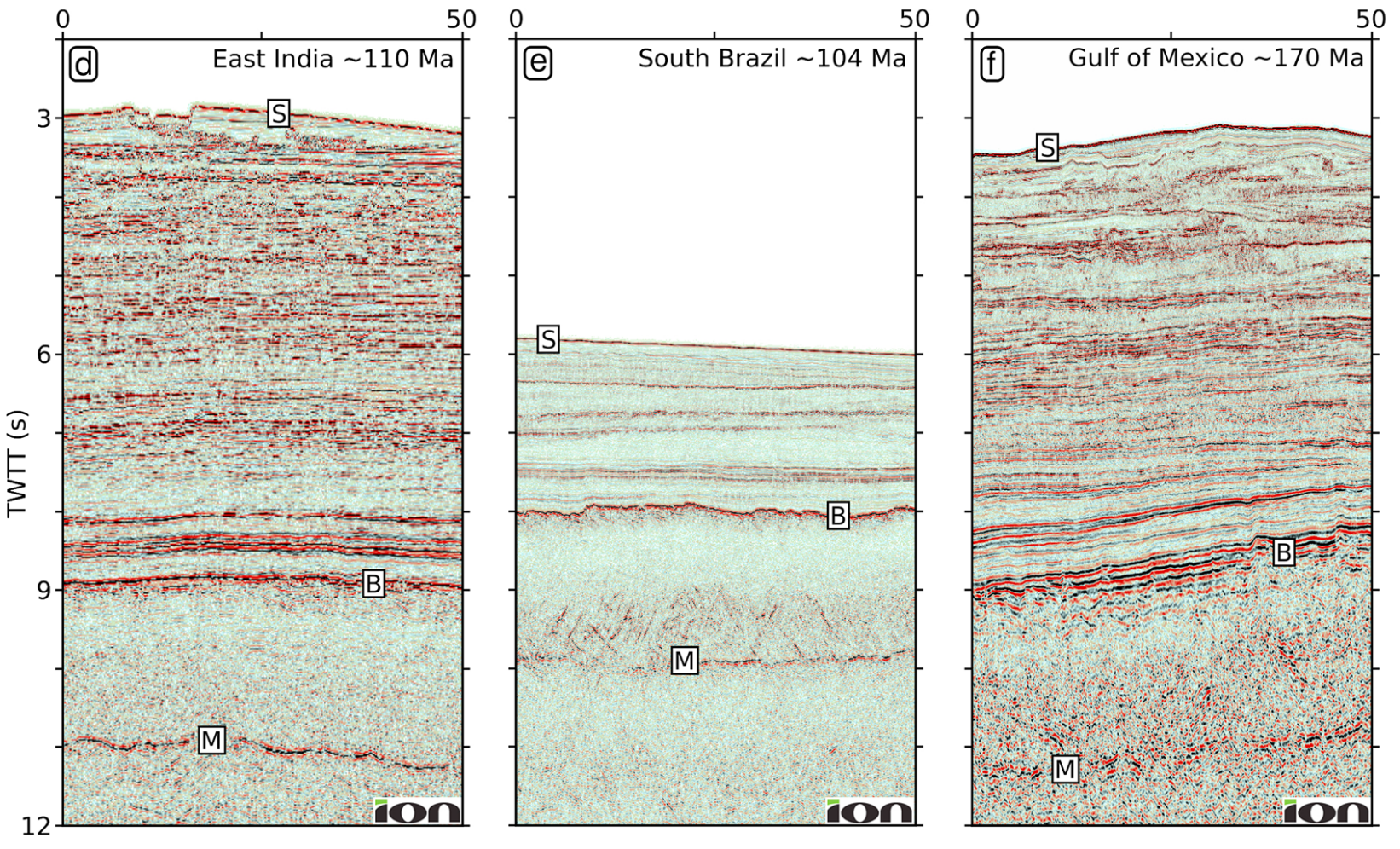
Mohorovičić discontinuity
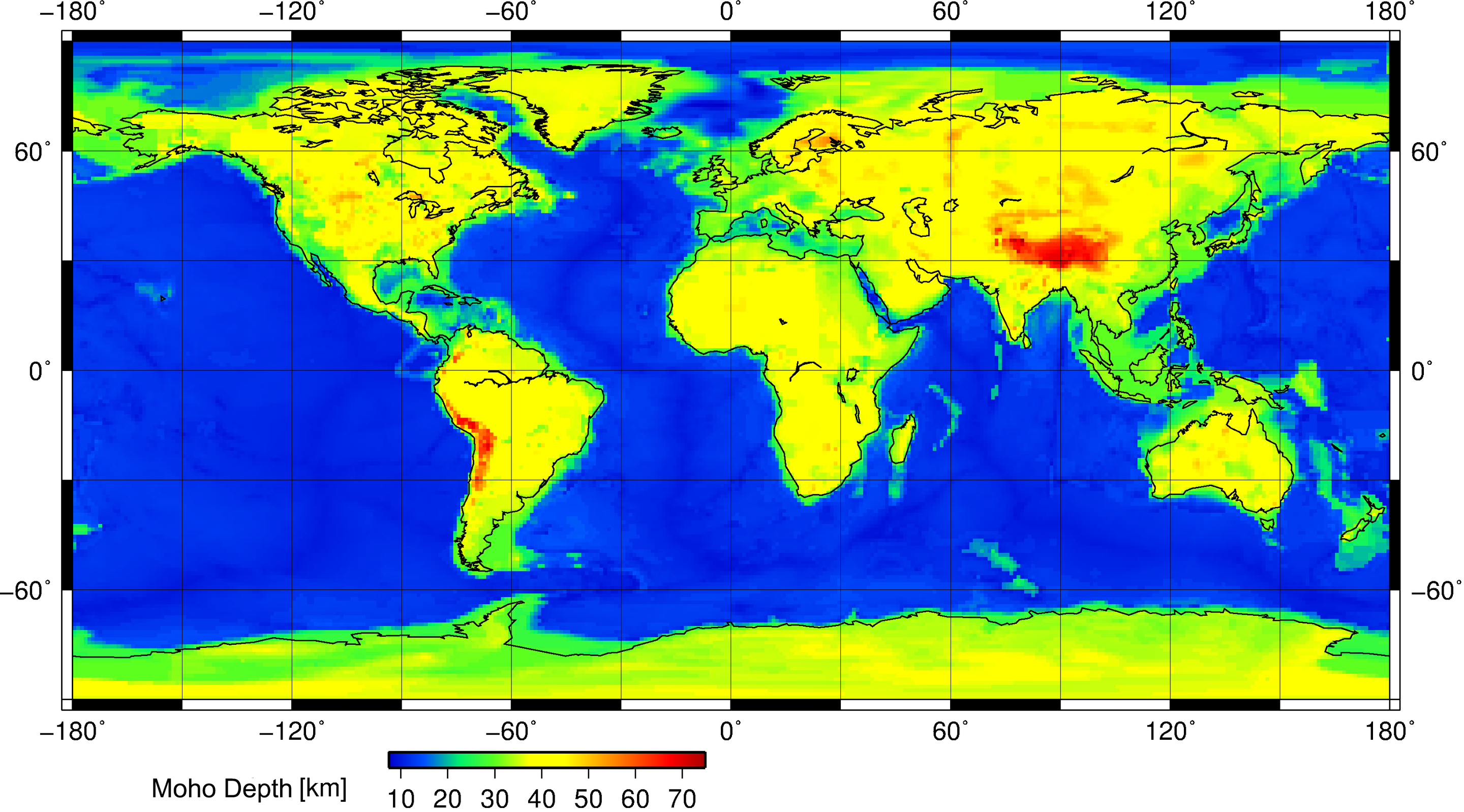
Mohorovičić discontinuity
What are the differences between lithosphere and asthenosphere and crust and mantle?
Mohorovičić discontinuity
Mohorovičić discontinuity
Mohorovičić discontinuity
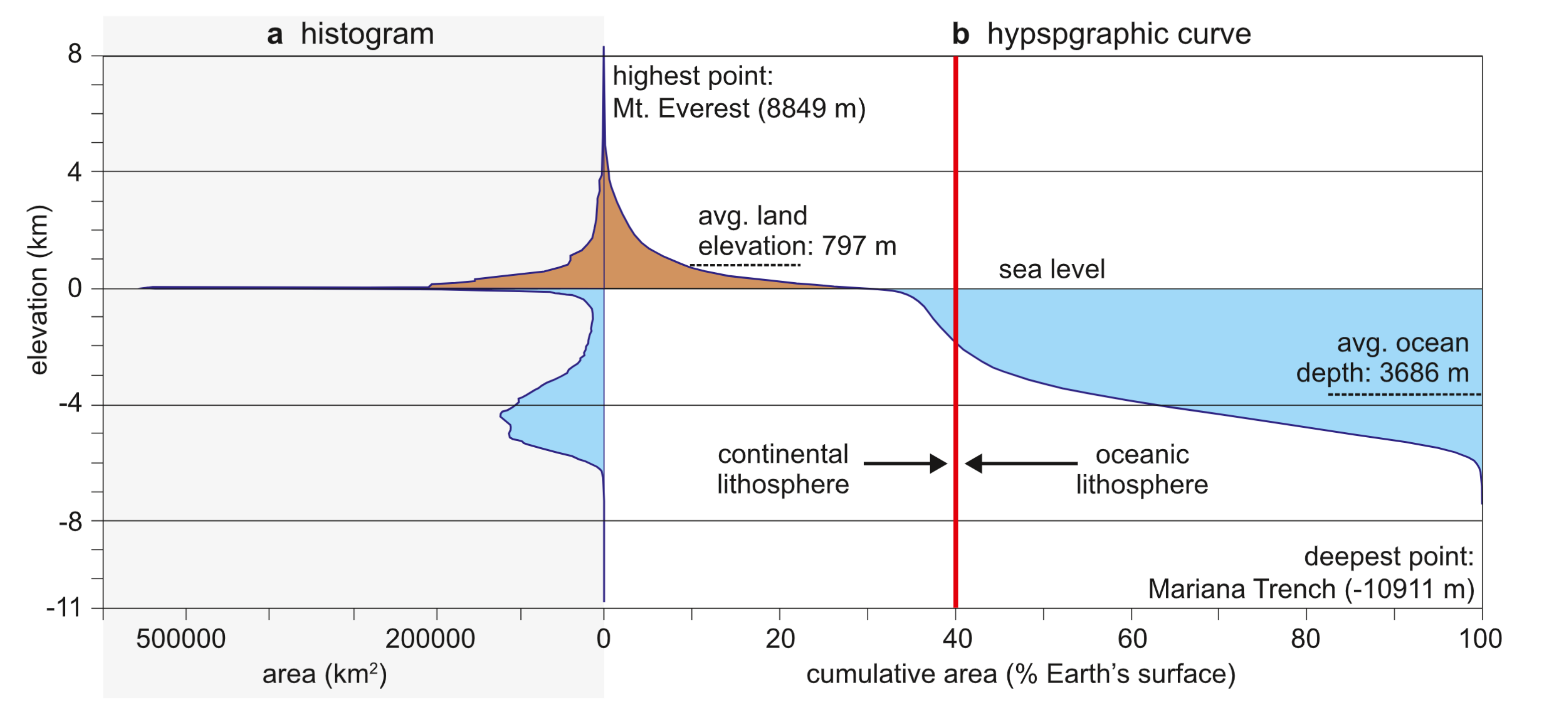
Testing isostatic equilibrium
- Continental crust:
- Mean elevation: 797 m
- Mean thickness: 34 km
- Andesite with density: 2.8 g/cm3
- Density of water: 1 g/cm3
- Oceanic crust:
- Mean elevation: -3686 m
- Mean thickness: 6 km
- Basalt with density: 2.9 g/cm3
Testing isostatic equilibrium
The calculation is simplest if we assume compensation depth is the base of the continental crust (instead of the 40 km hypothetical posed by Hess). You should get 3.46 g/cm3 (density of peridotite: 3.1–3.4 g/cm3) using the following mass balance:
$$ \mathrm{ \Delta H_{cc}\rho_{cc} = \Delta H_{w}\rho_{w} + \Delta H_{oc}\rho_{oc} + \Delta H_m\rho_m \\ ~\\ \Delta H_{cc}\rho_{cc} - \Delta H_{w}\rho_{w} - \Delta H_{oc}\rho_{oc} = \Delta H_m\rho_m \\ ~\\ \frac{\Delta H_{cc}\rho_{cc} - \Delta H_{w}\rho_{w} - \Delta H_{oc}\rho_{oc}}{\Delta H_m} = \rho_m \\ ~\\ \Delta H_m = \Delta H_{cc} - \Delta H_{oc} - E_{cc} - E_{oc}\\} $$where $\Delta H$ is thickness, $E$ is elevation, $\rho$ is density, and the subscripts $w$, $cc$, $oc$, and $m$ correspond to the water in the ocean, the continental crust, the oceanic crust, and the mantle, respectively.
crust_thickness = 34
crust_elevation = 0.797
crust_density = 2.8  # kg/m^3
ocean_thickness = 6
ocean_elevation = -3.686
ocean_density = 2.9  # kg/m^3
water_density = 1
water_thickness = 3.686
mantle_root = crust_thickness - ocean_thickness - (crust_elevation - ocean_elevation)

# crust_thickness*crust_density = water_thickness*water_density + ocean_thickness*ocean_density +
#                                                                           mantle_density*mantle_root
mantle_density = (
    water_thickness * water_density
    + crust_thickness * crust_density
    - ocean_thickness * ocean_density
) / mantle_root
mantle_density
3.4649827784156138
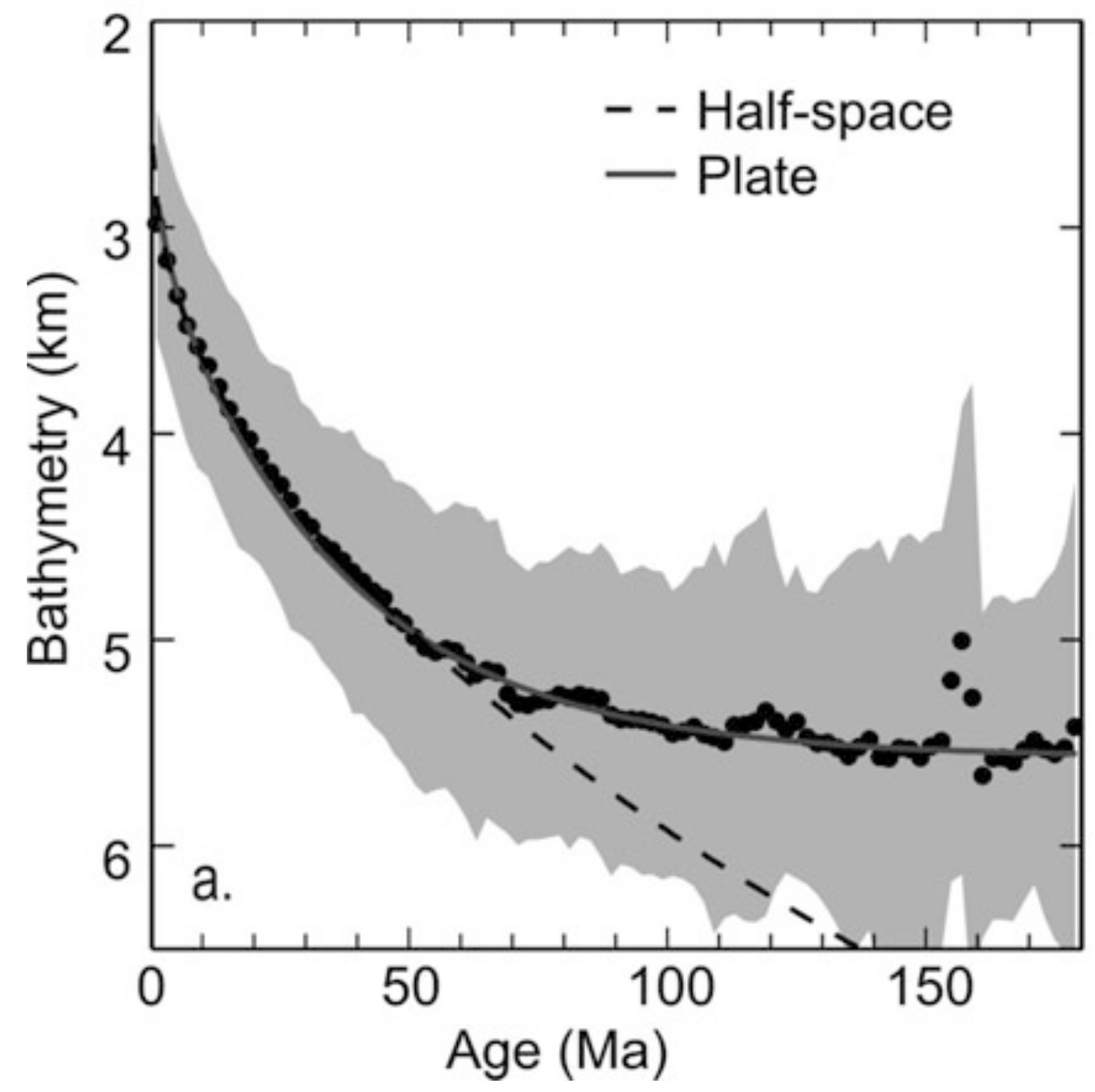
The topography of the sea-floor
The topography of the sea-floor
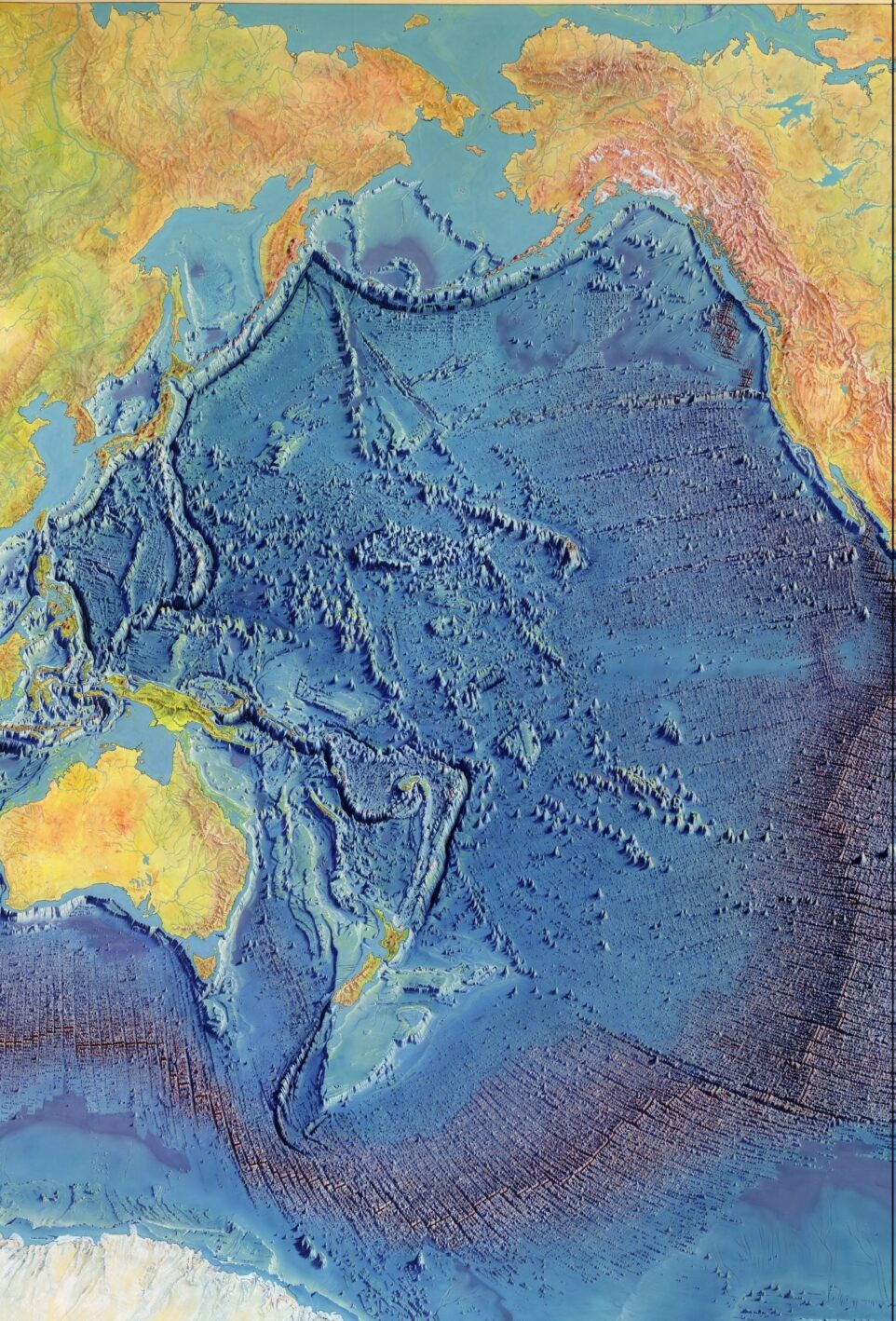
The topography of the sea-floor
The topography of the sea-floor
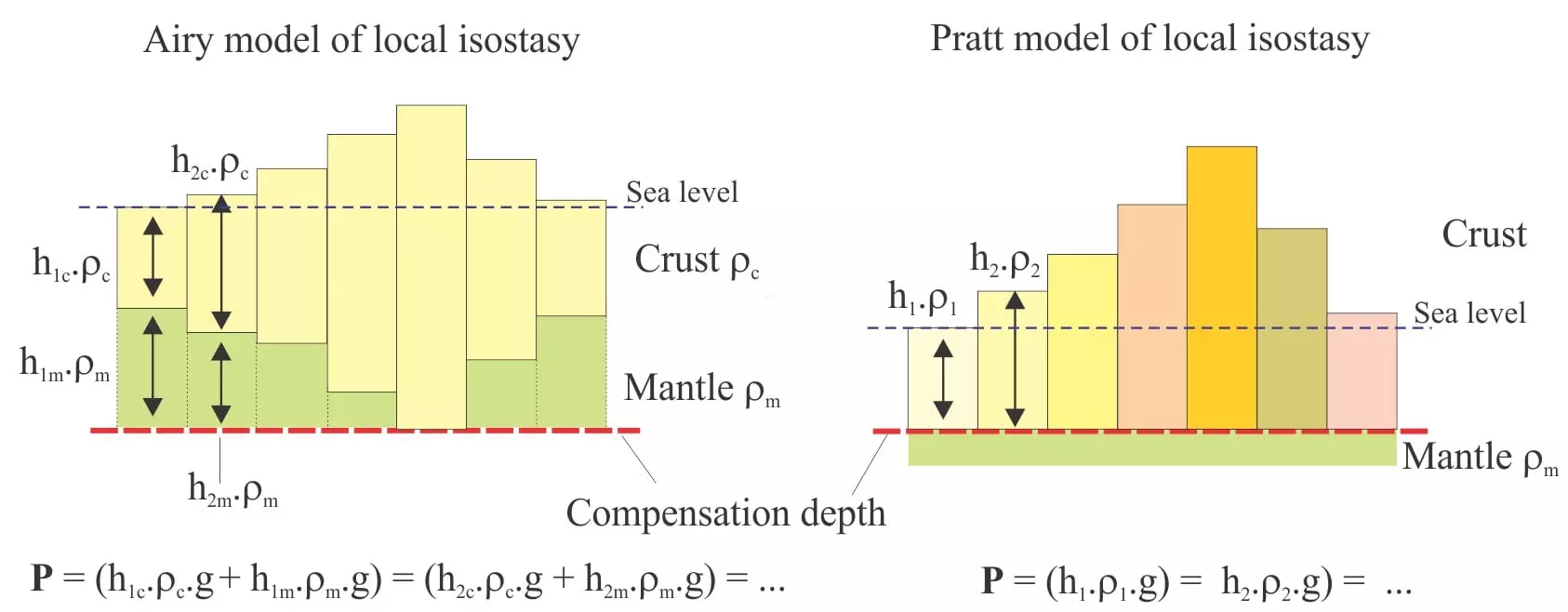
Which model is better at explaining sea-floor topography? Why?
The topography of the sea-floor
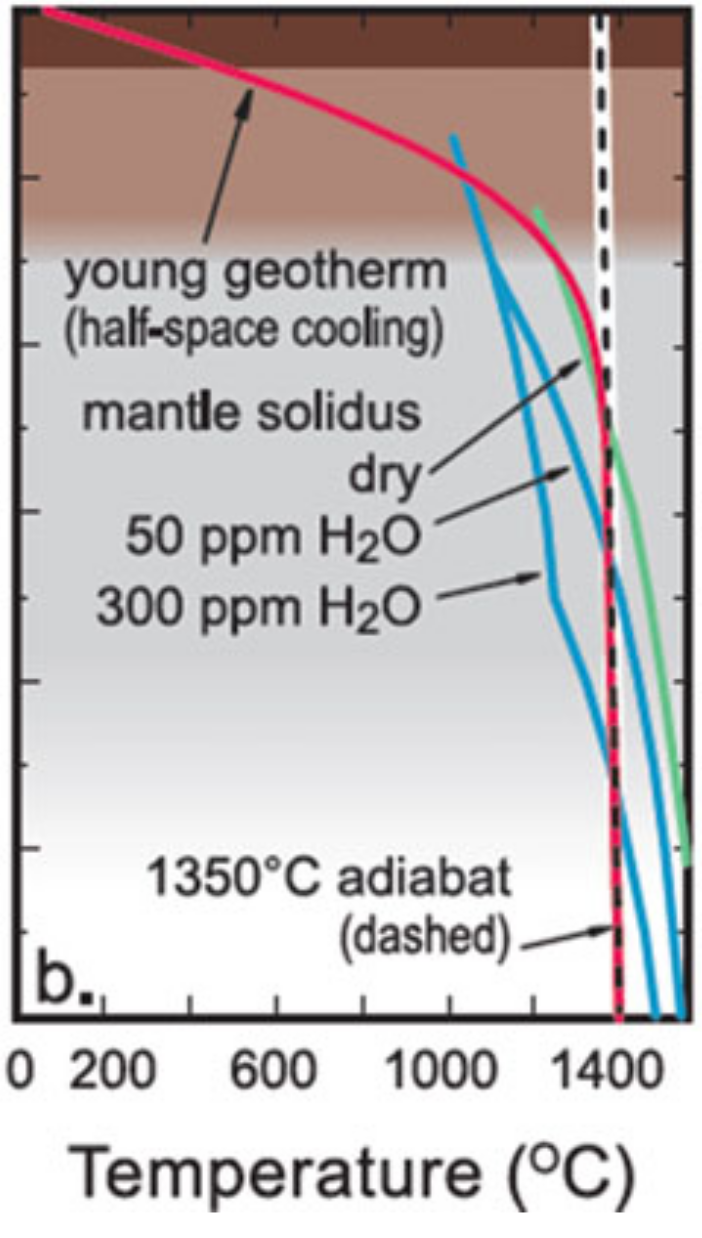
Temperature profile of Earth's lithosphere and upper asthenosphere (sketch first)
Temperature profile of Earth's lithosphere and upper asthenosphere (sketch first)
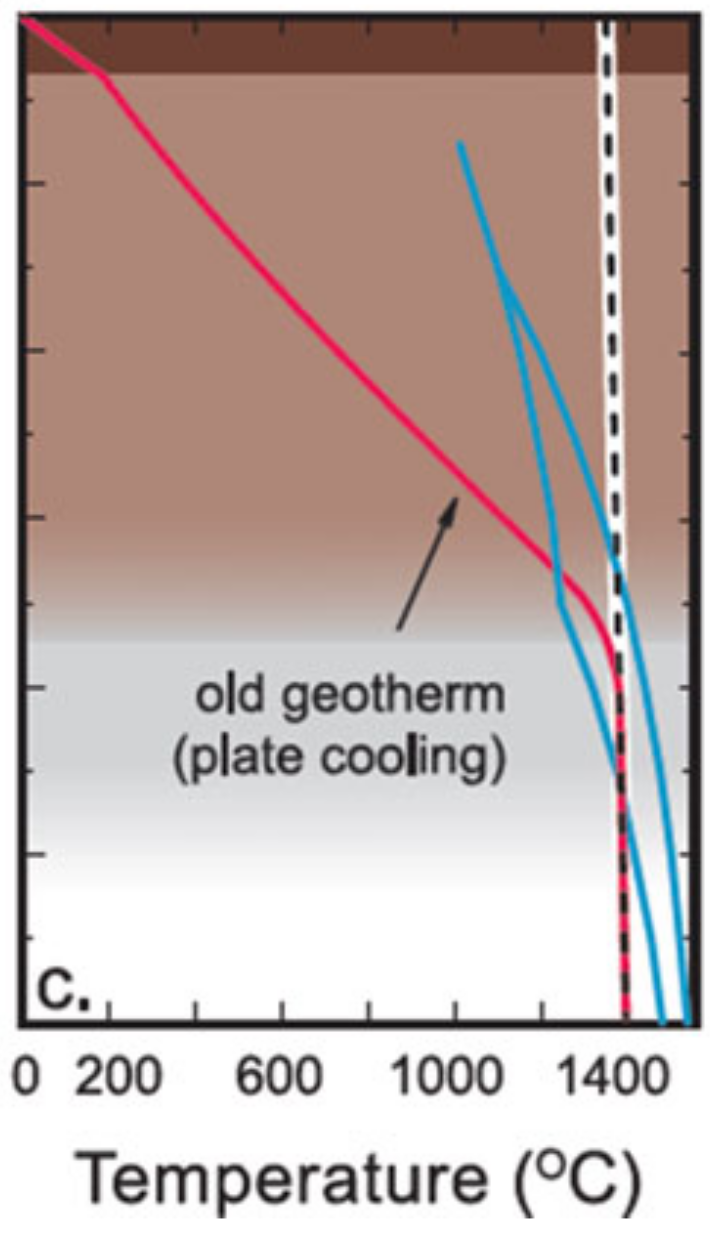
Temperature profile of Earth's lithosphere and upper asthenosphere (sketch first)
Heat flux (Fourier's law)
The differential form of Fourier's law of thermal conduction shows that the local heat flux density, $q$, is equal to the product of thermal conductivity, $k$, and the negative local temperature gradient, ${\partial T}/{\partial x}$. The heat flux density is the amount of energy that flows through a unit area per unit time.
$$ q = -k \frac{\partial T}{\partial x} $$How does temperature change over time through conduction?
The diffusion equation: $$ \frac{\partial T}{\partial t} = \frac{\partial q}{\partial x} $$
$$ \frac{\partial T}{\partial t} = -k \frac{\partial^2 T}{\partial x^2} $$Heat flux (Fourier's law)
- Using your intuition of diffusion, draw some sketches showing:
- Temperature profile of asthenosphere (1400 $^\circ$C) instantly brought to the surface (0 $^\circ$C)
- Temperature profile of this asthenosphere after an intermediate time
- Temperature profile of this asthenosphere after a long time
How does heat flux, $q$, change at the surface in each instance?
- Draw a sketch of a mid ocean ridge, annotating the crust, the lithosphere-asthenosphere boundary, and a few isotherms (temperature contours)
Heat flux observations
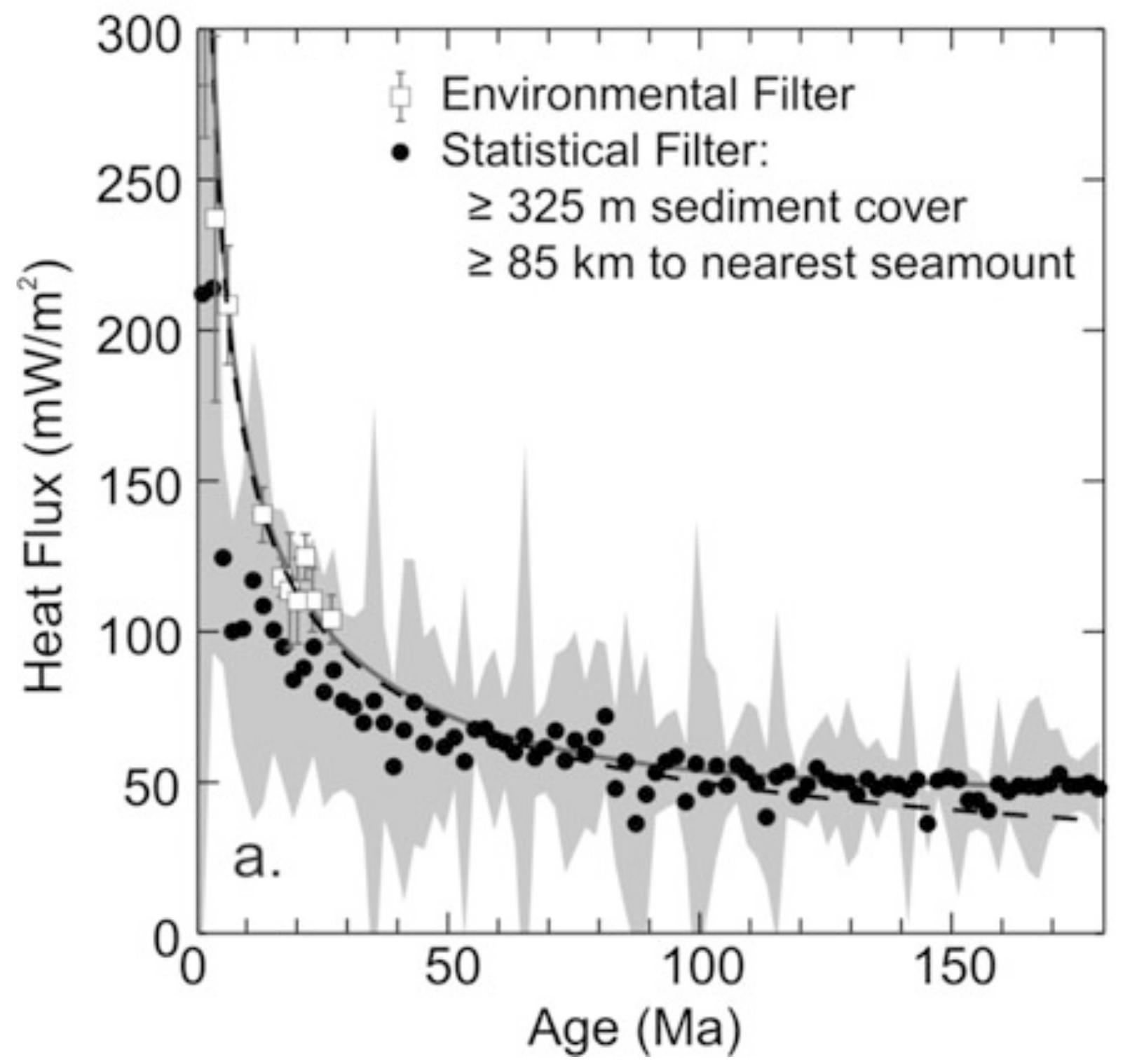
Heat flux observations
Heat flux observations
Younger sea-floor has hydrothermal cooling (lower heat flux than expected). We'll take a closer look at the old sea-floor problem soon!
Boundary Layer Model (cooling of an infinite half-space)