Lecture 14: The Long Term Carbon Cycle
- The temperature of the Earth
- A faint young Sun
- The necessity of a negative feedback
- The (long-term) Carbon cycle
- Finite-difference solutions to differential equations
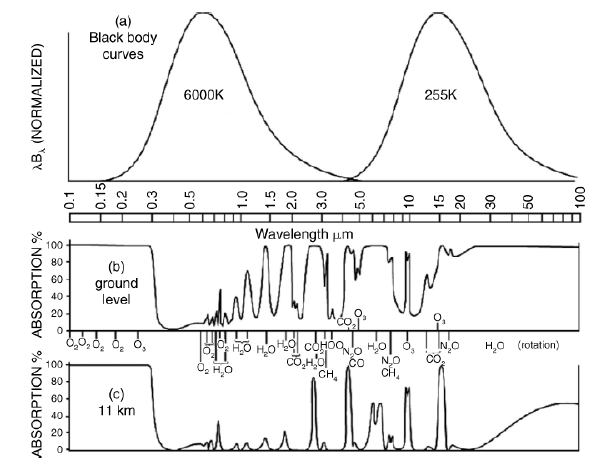
What sets the temperature of the Earth?
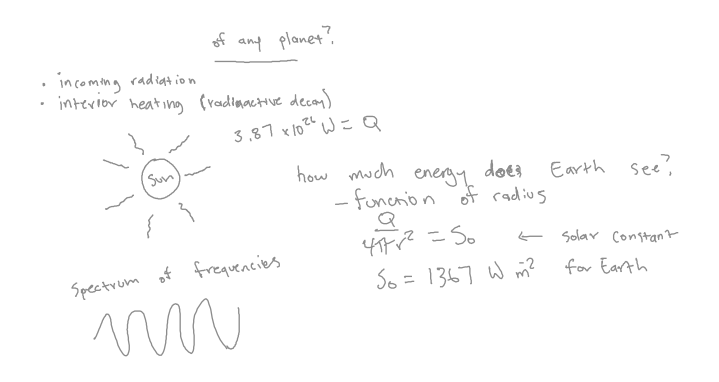
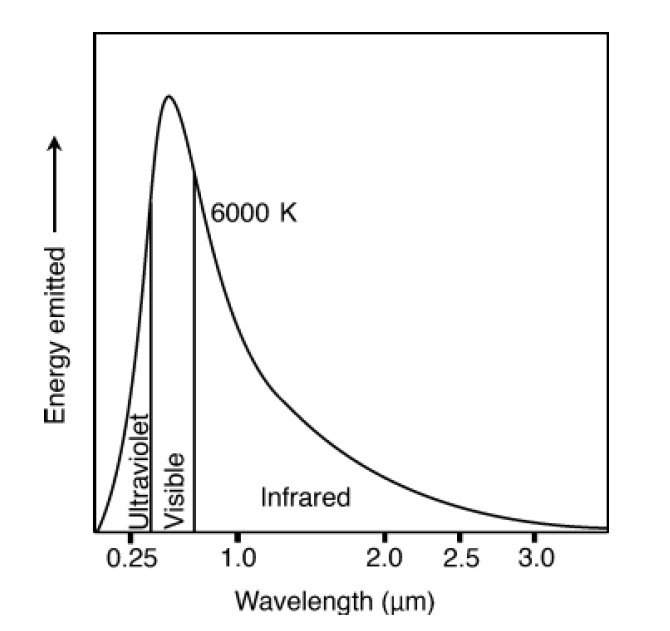
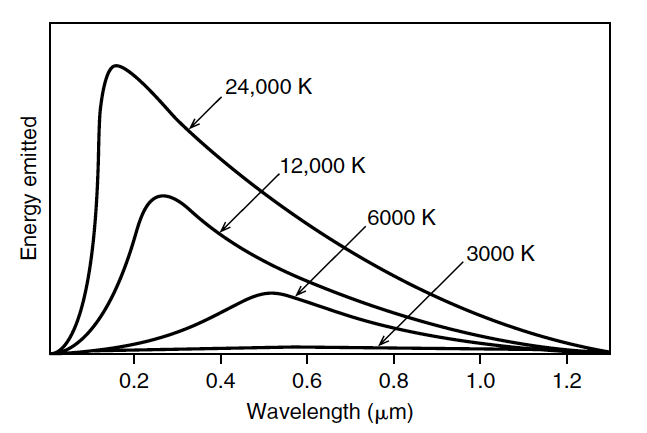
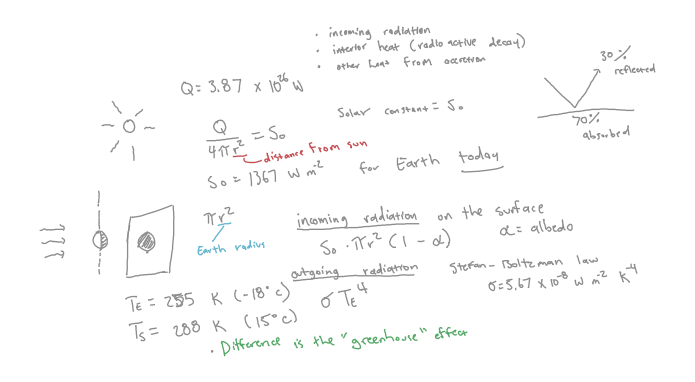
Calculating the 'emission' temperature of Earth
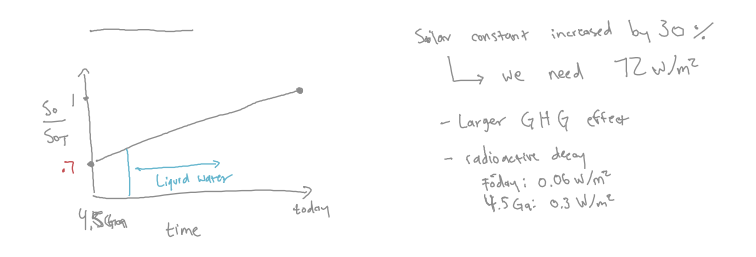
A faint young Sun and possible solutions
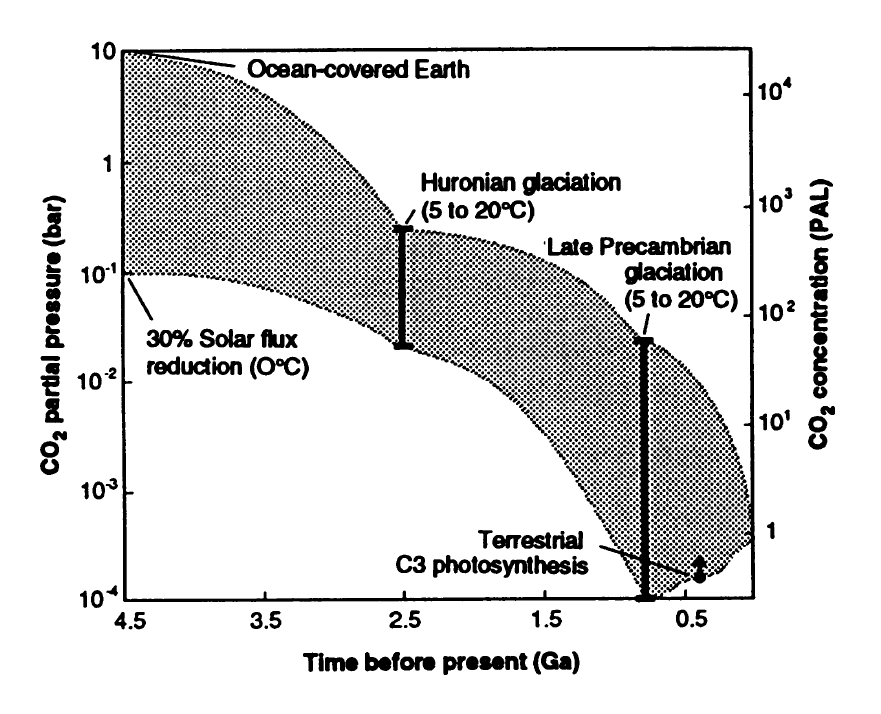
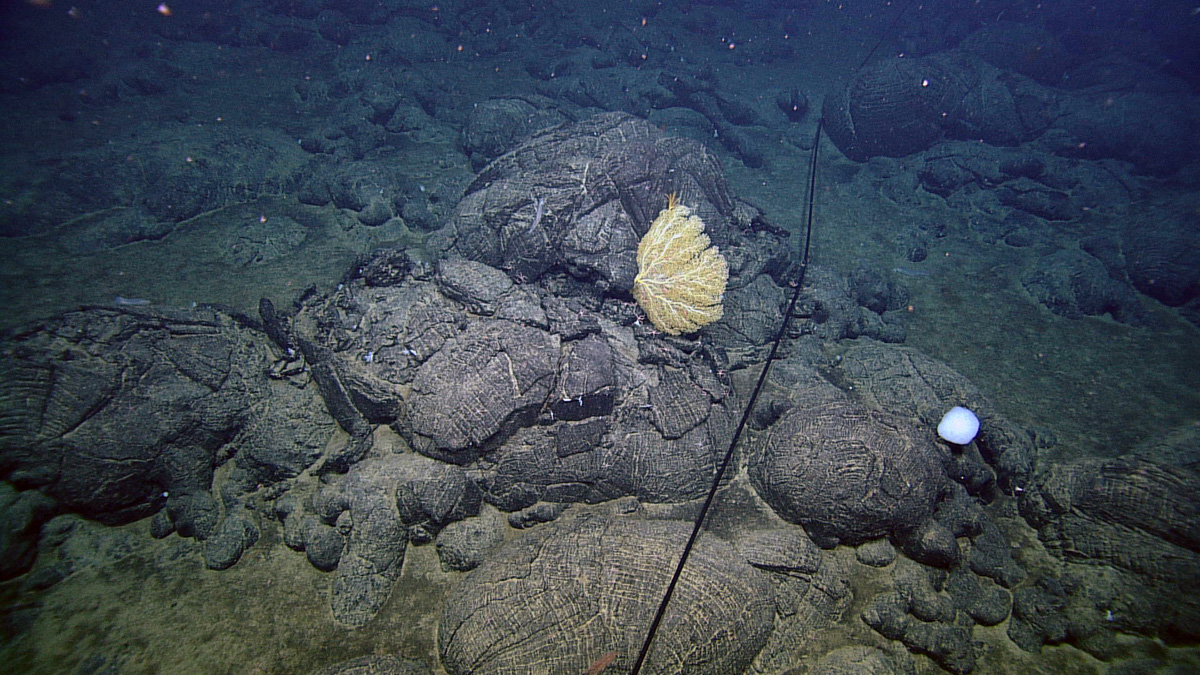
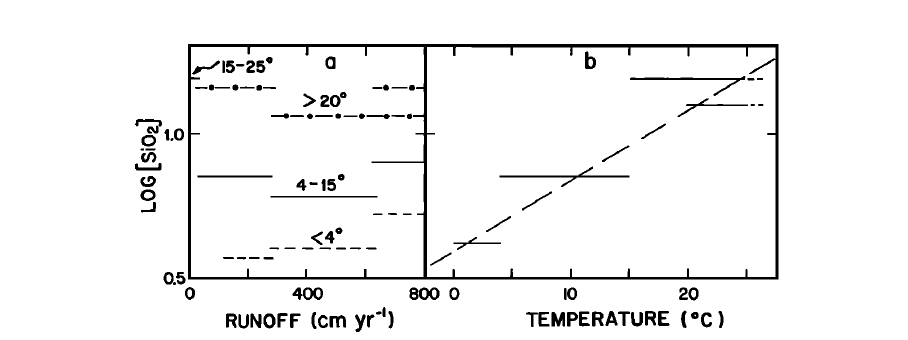
The silicate weathering feedback
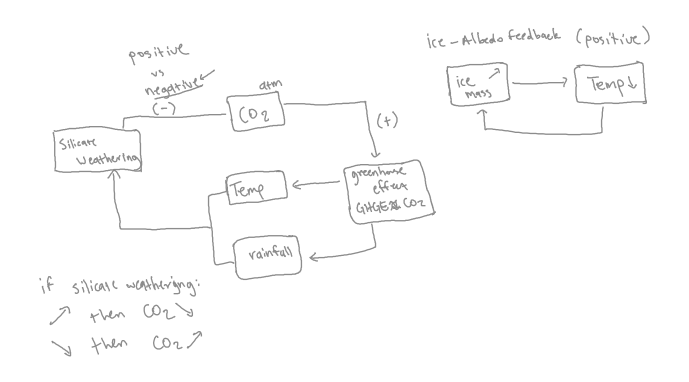
Feedbacks
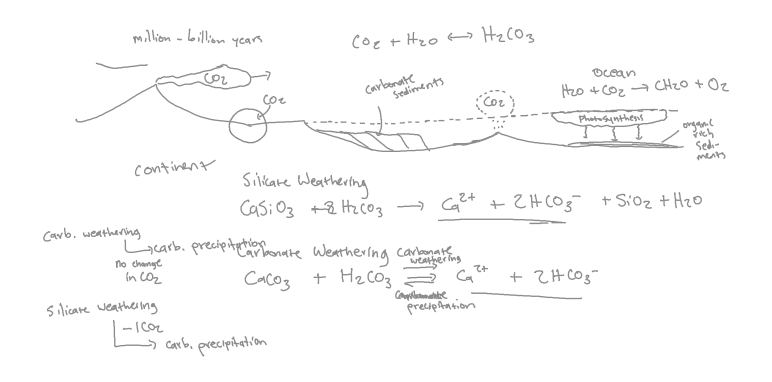
The long term carbon cycle (conceptual)
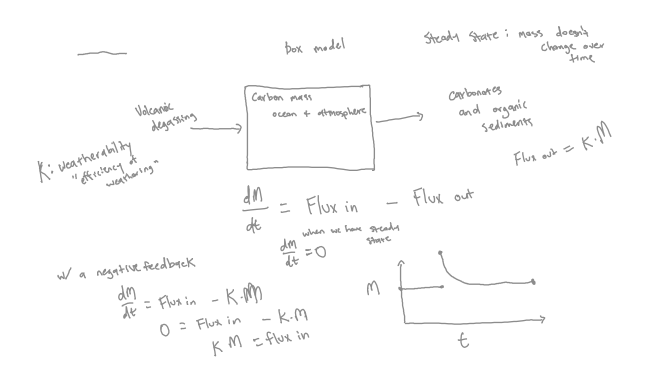
The long term carbon cycle (a model)
How does climate change?
The Derivative Function
Recall: what is the definition of the derivative function $f'(x)$?
While we can't calculate $\Delta x$ and $\Delta f$ for $\lim{(\Delta x\to0)}$ CPUs have no trouble calculating $\dfrac{\Delta f}{\Delta x}$ for a sufficiently small value of $\Delta x$
Finite difference methods
In fact, we have many possible approaches to estimating derivatives using sufficiently small values of $\Delta x$, and these methods are collectively known as finite difference methods. These methods make use of Taylor's theorem:
$\begin{equation} f(x + \Delta x) = f(x) + \dfrac{f'(x)}{1!}(\Delta x) + \dfrac{f''(x)}{2!}(\Delta x)^2 + ... \end{equation} \label{eq:taylor}\tag{Taylor series} $
What happens to the size of each higher order term in the series?
We describe the error of an approximation by the degree of the term where the series is truncated. First order: $O(\Delta x)$, second order: $O(\Delta x^2)$, third order: $O(\Delta x^3)$, etc...
$$ \begin{equation} f(x + \Delta x) \color{red}{\approx} f(x) + \dfrac{f'(x)}{1!}(\Delta x) \color{Gray}{+ \dfrac{f''(x)}{2!}(\Delta x)^2 + ...} \end{equation} $$We can use small $\Delta x$ and a first order truncation of the Taylor series to estimate $f(x + \Delta x)$